Book 24: Hermes Leads the Suitors; Peace Concluded in Ithaca
Ὀδύσσεια · Book 24 · Classix Modern English Reading Edition
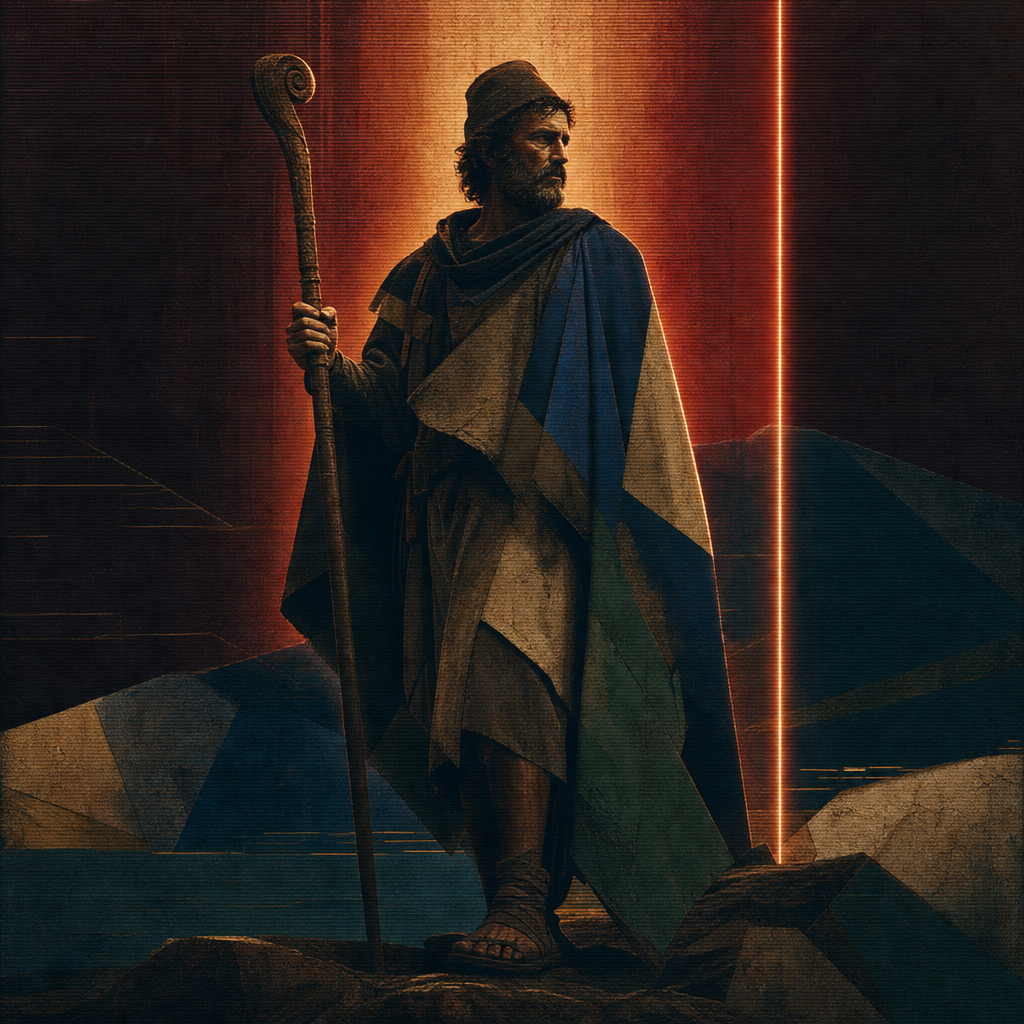
Hermes of Cyllene called forth the spirits of the suitors. He held in his hands the beautiful golden wand with which he enchants the eyes of any men he chooses, or wakes them from sleep. He moved it and led them on; they followed squeaking. As bats deep in a wondrous cave fly squeaking when one falls from the chain on a rock, where they cling to one another, so the spirits went together, squeaking, while Hermes the kindly led them down the dank paths. They passed the streams of Ocean and the White Rock, the gates of the Sun and the land of dreams, and soon reached the asphodel meadow, where spirits dwell, the images of the dead.
Read Ancient Greek Source (Odyssey.24.1–Odyssey.24.14)
They found the spirit of Achilles, Peleus’ son, and those of Patroclus, blameless Antilochus, and Ajax, who after blameless Achilles was the finest of the Danaans in beauty and stature. As these gathered around Achilles, the grieving spirit of Agamemnon, Atreus’ son, came near. Other spirits clustered about him, all who had died with him in Aegisthus’ house and met their fate. The spirit of Peleus’ son spoke first. “Son of Atreus, we used to say you were dearer than any other hero all your days to Zeus who delights in thunder, because you ruled so many strong men in the land of Troy, where we Achaeans suffered. Yet destructive fate, which no one born can escape, was to stand beside you early too. If only you had met death and doom in the land of Troy, enjoying the honor of your rule! All the Achaeans would have built you a mound, and you would have won great glory for your son in days to come. But now it was your fate to be caught by the most pitiful death.”
Read Ancient Greek Source (Odyssey.24.15–Odyssey.24.34)
The spirit of Atreus’ son answered him. “Fortunate son of Peleus, Achilles like the gods! You died at Troy, far from Argos. Around you the finest sons of Trojans and Achaeans were killed, fighting over you. You lay great in your greatness in a whirl of dust, your horsemanship forgotten. We fought all day, and would never have stopped if Zeus had not stopped us with a storm. When we carried you from battle to the ships, we washed your beautiful body with warm water and oil and laid you on a bed. Around you the Danaans shed many hot tears and cut their hair. Your mother came out of the sea with the immortal sea women when she heard the news. An unearthly cry rose over the water, and trembling seized all the Achaeans. They would have leaped up and fled to the hollow ships if a man who knew many things of old had not restrained them: Nestor, whose counsel had always seemed best before. With their good at heart he addressed them. ‘Hold, Argives! Young men of the Achaeans, don’t flee. Here is his mother, coming from the sea with the immortal sea women to meet her dead son.’
Read Ancient Greek Source (Odyssey.24.35–Odyssey.24.56)
“So he spoke, and the great-hearted Achaeans held back from flight. The daughters of the old man of the sea stood around you, lamenting piteously, and dressed you in immortal clothes. All nine Muses answered one another with lovely voices as they sang your dirge. You would have seen no Argive without tears, so deeply did the clear-voiced Muse stir them. For seventeen nights and days we mourned you, immortal gods and mortal men together. On the eighteenth we gave you to the fire, slaughtering many fat sheep and crumple-horned cattle around you. You burned in the clothing of the gods, with much oil and sweet honey. Many Achaean heroes moved briskly in armor around your burning pyre, men on foot and in chariots, and a great din arose. When the flame of Hephaestus had consumed you, at dawn we gathered your white bones, Achilles, with unmixed wine and oil. Your mother gave a golden two-handled jar; she said it was Dionysus’ gift, the work of far-famed Hephaestus.
Read Ancient Greek Source (Odyssey.24.57–Odyssey.24.75)
“In it lie your white bones, splendid Achilles, mingled with those of dead Patroclus, Menoetius’ son. Antilochus’ lie apart; of all your other companions you honored him most after Patroclus died. Around them we, the sacred host of Argive spearmen, raised a great and flawless mound on a projecting headland by the broad Hellespont, so it could be seen far out at sea by men alive today and those who will come after. Your mother asked the gods for beautiful prizes and set them in the midst of the gathering for the best of the Achaeans. You have attended the funerals of many heroes, when young men gird themselves and prepare contests after a king has died. But you would have marveled most of all at the beautiful prizes the goddess, silver-footed Thetis, set out for you. You were very dear to the gods. So even in death you have not lost your name, Achilles. Your noble fame will live forever among all people. But what pleasure is left for me, now I have wound my way through war? At my return Zeus devised a grievous death for me at the hands of Aegisthus and my accursed wife.”
Read Ancient Greek Source (Odyssey.24.76–Odyssey.24.97)
While they spoke together, the messenger, slayer of Argus, came near, bringing down the spirits of the suitors whom Odysseus had overcome. The two were astonished at the sight and went straight toward them. The spirit of Agamemnon, Atreus’ son, recognized famed Amphimedon, Melaneus’ dear son, who lived in Ithaca and was his guest-friend. The spirit of Atreus’ son spoke first. “Amphimedon, what has happened to bring you all beneath the dark earth, chosen men of the same age? Anyone choosing the best men through a city could not have picked otherwise. Did Poseidon overcome you in your ships, stirring up harsh winds and long waves? Or did enemies harm you on land as you cut off cattle and fine flocks of sheep, or fought for a city or its women? Answer my question. I claim to be your guest-friend. Don’t you remember when I came to your house there with godlike Menelaus, urging Odysseus to follow us to Ilium in the well-benched ships? It took a whole month before we crossed all the wide sea, having with difficulty persuaded Odysseus, sacker of cities.”
Read Ancient Greek Source (Odyssey.24.98–Odyssey.24.119)
The spirit of Amphimedon answered him. “Most glorious son of Atreus, Agamemnon, lord of men, I remember it all, fostered by Zeus, just as you say. I will tell you everything fully and truly, the evil end of our death and how it happened. We were courting the wife of long-absent Odysseus. She neither refused the hateful marriage nor brought it to fulfillment, devising death and black doom for us. She thought of this other trick in her heart: she set up a great loom in the hall and wove a fine, very wide cloth. At once she said to us, ‘Young men, my suitors, since godlike Odysseus has died, eager as you are for my marriage, wait until I finish this cloth, so my thread will not be wasted: a burial shroud for the hero Laertes, for the time when the destructive fate of grievous death brings him down. I don’t want some Achaean woman in the town to blame me if a man who won so many possessions lies without a winding sheet.’ So she spoke, and our proud hearts agreed. By day she wove at the great loom; by night she set torches beside her and unraveled it. For three years she kept the trick hidden and persuaded the Achaeans. But when the fourth year came, as the seasons passed, the months waned and many days completed their course, one of the women who knew it well told us, and we found her unraveling the splendid web. So she finished it, unwilling, under compulsion.
Read Ancient Greek Source (Odyssey.24.120–Odyssey.24.146)
“When she had woven the great cloth, washed it and shown it bright as the sun or moon, then an evil god brought Odysseus from somewhere to the edge of the country, where the swineherd had his home. There godlike Odysseus’ dear son came too, returning in his black ship from sandy Pylos. The two prepared an evil death for the suitors and came to the renowned city, Odysseus later, Telemachus leading the way ahead. The swineherd brought him in wretched clothes, like a miserable old beggar, leaning on a staff, with those sorry clothes about his body. None of us could recognize him when he suddenly appeared, not even the older men. We abused him with foul words and hurled things at him. For a time he endured the missiles and abuse in his own hall with a steadfast heart. But when the mind of Zeus who bears the aegis roused him, he took up the beautiful weapons with Telemachus, put them in the storeroom and shot the bolts. Then, with great cunning, he told his wife to set the bow and gray iron before the suitors, a contest for us doomed men and the beginning of our murder.
Read Ancient Greek Source (Odyssey.24.147–Odyssey.24.169)
“None of us could stretch the strong bow’s string. We fell far short. When the great bow came toward Odysseus’ hands, we all shouted not to give it to him, however much he said. Telemachus alone urged it and gave the order. Steadfast, godlike Odysseus took it in his hand, easily strung the bow and shot through the iron. He went to stand on the threshold and poured out the swift arrows, glaring terribly, and struck lord Antinous. Then he sent groan-bringing arrows at the others, aiming straight, and they fell close together. It was plain that some god was helping them. At once they pursued us through the house in their fury and killed us on every side. Hideous groaning rose as heads were battered, and the whole floor seethed with blood. So we perished, Agamemnon. Even now our bodies lie uncared for in Odysseus’ house. Our friends in each of our homes do not yet know. They would wash the dark blood from our wounds, lay us out and mourn us, the honor that belongs to the dead.”
Read Ancient Greek Source (Odyssey.24.170–Odyssey.24.190)
The spirit of Atreus’ son answered him. “Fortunate son of Laertes, Odysseus of the many devices! You won a wife of great excellence. How good was the mind of blameless Penelope, Icarius’ daughter! How well she remembered Odysseus, the husband she married. So the fame of her excellence will never perish. The immortals will make a graceful song for people on earth about sensible Penelope. Not so Tyndareus’ daughter, who devised evil deeds and killed her wedded husband. Hers will be a hateful song among men, and she will give a harsh name to women, even one who does good.” So they spoke to one another, standing in the house of Hades beneath the depths of earth.
Read Ancient Greek Source (Odyssey.24.191–Odyssey.24.204)
Meanwhile the others left the city and soon reached Laertes’ fine, well-tended farm, which he himself had acquired through much toil. There stood his house, with a shelter running all around, where the slaves bound to work for him ate, sat and slept. An old Sicel woman lived there and tenderly cared for the old man on the farm, far from town. Odysseus spoke to the slaves and his son. “Go into the well-built house now, and quickly slaughter the best pig for a meal. I will test our father to see whether he knows me and recognizes me with his eyes, or fails to know me after so long apart.” He gave the slaves his weapons of war. They quickly went to the house, while Odysseus drew nearer to the fruitful plot to make his test. Going down into the great orchard, he did not find Dolius, or any of the slaves or sons. They had gone to build stone walls to enclose the plot, and the old man Dolius was leading them along the road.
Read Ancient Greek Source (Odyssey.24.205–Odyssey.24.225)
He found his father alone in the well-kept plot, digging around a plant. He wore a filthy, patched, wretched tunic, with stitched oxhide guards bound around his shins to keep off scratches, and gloves on his hands against the brambles. On his head was a goatskin cap, deepening the look of grief. When steadfast, godlike Odysseus saw him worn down by age, with great sorrow in his heart, he stood beneath a tall pear tree and shed tears. Then he pondered in his mind and heart whether to kiss and embrace his father and tell him everything, how he had come to his native land, or first question him and test him in each detail. As he thought, it seemed better to test him first with teasing words. With that in mind godlike Odysseus went straight toward him.
Read Ancient Greek Source (Odyssey.24.226–Odyssey.24.240)
Laertes was digging around a plant with his head bent low. His splendid son stood beside him and spoke. “Old man, no lack of knowledge keeps you from tending this orchard. It is well cared for: not a single plant, fig tree, vine, olive, pear tree or garden bed here lacks care. But I’ll tell you something else, and don’t take it angrily to heart. You yourself are not well cared for. You bear a miserable old age, are badly unkempt and wear wretched clothes. It can’t be because you are idle that your master neglects you, and there is nothing slavish about your appearance or height when I look at you. You look like a king. You look like a man who, after bathing and eating, should sleep softly, as is the right of old men. But tell me this fully and truly: whose slave are you? Whose orchard do you tend? And tell me truly, so I can be sure, whether this is really Ithaca, as a man I just met on my way here told me. He had little sense. He would not bring himself to tell me everything or listen to my words when I asked about my guest-friend, whether he still lives or has died already and is in the house of Hades.
Read Ancient Greek Source (Odyssey.24.241–Odyssey.24.264)
“I will tell you; take it to heart and listen. I once welcomed a man in my own country when he came to our home. No other traveler from far away was ever so welcome in my house. He said he was of Ithacan birth and that Laertes, Arceisius’ son, was his father. I took him home and entertained him well, welcoming him warmly from the plentiful stores in my house. I gave him fitting gifts of hospitality: seven talents of worked gold, a solid silver mixing bowl with flower decoration, twelve single cloaks, as many rugs, as many fine mantles and as many tunics besides. Separately I gave him four beautiful women, skilled in excellent work, whom he chose himself.”
Read Ancient Greek Source (Odyssey.24.265–Odyssey.24.279)
His father answered him, shedding tears. “Stranger, you have indeed reached the land you ask about, but insolent, reckless men possess it. You gave all those countless gifts in vain. If you had found him alive in the land of Ithaca, he would have sent you off well repaid with gifts and good hospitality, as is right when someone has first shown kindness. But tell me this fully and truly: how many years is it since you entertained that unhappy guest-friend of yours, my son—if ever he existed—ill-fated man? Far from his friends and native land, fish have eaten him in the sea somewhere, or he has become prey for beasts and birds on land. Neither his mother nor I, the parents who bore him, wrapped and mourned him. Nor did his richly dowered wife, sensible Penelope, close his eyes and lament her husband on his bed, as was fitting. That is the honor of the dead. And tell me truly, so I can be sure: who are you, where do you come from, where are your city and parents? Where is the swift ship that brought you here with your godlike companions? Or did you come as a passenger on someone else’s ship, and have they put you ashore and gone?”
Read Ancient Greek Source (Odyssey.24.280–Odyssey.24.301)
Odysseus, master of schemes, answered him. “I will tell you everything fully and truly. I am from Alybas, where I live in a splendid house, the son of lord Apheidas, Polypemon’s son. My own name is Eperitus. A god drove me off course from Sicania to come here against my will. My ship lies here by the fields, far from the city. This is already the fifth year since Odysseus left that place and sailed from my homeland, unhappy man. Yet he had good birds as he set out, on the right. Rejoicing in them I sent him away, and he rejoiced as he went. Our hearts still hoped that we would meet again in hospitality and give splendid gifts.”
Read Ancient Greek Source (Odyssey.24.302–Odyssey.24.314)
A black cloud of grief covered Laertes. He took sooty dust in both hands and poured it over his gray head, groaning thickly. Odysseus’ spirit stirred. A sharp pang already stung his nostrils as he looked at his dear father. He sprang to him, embraced and kissed him, and spoke. “Father, I am the man himself, here before you, the one you ask about. I have come to my native land in the twentieth year. Stop your tears and tearful lamenting. I will tell you, though we must hurry: I have killed the suitors in our hall, punishing their bitter insults and wicked deeds.” Laertes answered him. “If you really are Odysseus, my son, come here at last, tell me some unmistakable sign now, so I can trust you.” Odysseus, master of schemes, replied, “First look at this scar with your own eyes, where a boar struck me with its white tusk on Parnassus when I went there. You and my honored mother sent me to Autolycus, my mother’s dear father, to receive the gifts he had promised and pledged me when he came here.
Read Ancient Greek Source (Odyssey.24.315–Odyssey.24.335)
“Come, I’ll tell you too of the trees in this well-kept plot that you once gave me. I was a child, following you through the orchard, asking you for each one. We went among them, and you named and told me each. You gave me thirteen pear trees, ten apple trees and forty fig trees. You named fifty rows of vines to give me as well, each bearing its harvest in turn. There are grapes of every kind there, when Zeus’ seasons weigh down on them from above.” His father’s knees and dear heart gave way as he recognized the sure signs Odysseus described. He threw his arms around his dear son, and steadfast, godlike Odysseus drew him close as he fainted. When he recovered his breath and his spirit gathered in his heart, he spoke again. “Father Zeus, you gods still do exist on high Olympus, if the suitors have truly paid for their reckless insolence! But now I am terribly afraid that all the Ithacans will soon come here against us, and send messages everywhere to the cities of the Cephallenians.” Odysseus, master of schemes, answered him. “Take courage. Don’t let these things trouble your mind. Let us go to the house near the orchard. I sent Telemachus, the cattle keeper and the swineherd ahead to prepare a meal as quickly as they could.”
Read Ancient Greek Source (Odyssey.24.336–Odyssey.24.360)
They went to the fine house. When they reached the well-appointed rooms, they found Telemachus, the cattle keeper and the swineherd cutting up plenty of meat and mixing gleaming wine. Meanwhile the Sicel attendant bathed great-hearted Laertes in his own house, anointed him with oil and put a fine cloak around him. Athena stood near and filled out the limbs of the shepherd of his people, making him taller and fuller to look at than before. He stepped out of the bath. His dear son marveled to see him like the immortal gods face to face, and spoke these flying words: “Father, one of the gods who live forever has surely made you finer to look at, in beauty and stature.” Sensible Laertes answered him. “Father Zeus, Athena and Apollo, if only I had been beside you yesterday in our hall, armor on my shoulders, warding off the suitors, as I was when I captured Nericus, the well-built city on a mainland headland, ruling the Cephallenians! Then I would have loosened many men’s knees in the hall, and you would have rejoiced in your heart.”
Read Ancient Greek Source (Odyssey.24.361–Odyssey.24.382)
So they spoke to one another. When the others had finished their work and prepared the feast, they sat in order on couches and chairs. They were beginning their meal when old Dolius came near with his sons, weary from work. Their mother, the old Sicel woman, had gone out to call them. She had raised them and lovingly tended the old man now that age had seized him. When they saw Odysseus and knew him in their hearts, they stood astonished in the hall. Odysseus addressed them gently. “Old man, sit down to the meal, and all of you put your amazement aside. We have been waiting a long time in the hall, eager to begin our food, always expecting you.” Dolius went straight toward him with both hands outstretched. Taking Odysseus’ hand, he kissed it at the wrist and spoke these flying words. “Dear friend, you have come back to us, who longed for you so much and no longer thought you would return. The gods themselves have brought you home. Health and great joy to you! May the gods give you happiness. But tell me truly, so I can be sure: does thoughtful Penelope already know for certain that you have returned, or shall we send a messenger?” Odysseus, master of schemes, answered him. “Old man, she knows already. Why should you trouble yourself with that?” Dolius sat down again on a polished stool. His sons likewise gathered around renowned Odysseus, greeting him with words and clasping his hands. Then they sat in order beside their father Dolius.
Read Ancient Greek Source (Odyssey.24.383–Odyssey.24.411)
As they attended to their meal in the house, Rumor the messenger sped everywhere through the city, telling the suitors’ hateful death and doom. On hearing it, people came from every direction with groans and lamentation to the front of Odysseus’ house. Each family carried its dead out of the house and buried them. Those from other cities they put aboard swift ships and sent home, each to his own place, with fishermen to take them. Then together they went to the gathering place, grieving in their hearts. When they were all assembled, Eupeithes stood and addressed them. Unforgettable grief lay in his heart for his son Antinous, the first man godlike Odysseus had killed. Shedding tears for him, he spoke. “Friends, this man has devised a monstrous deed against the Achaeans. He took many brave men away in his ships and lost the hollow ships and their people. Now he has returned and killed by far the finest of the Cephallenians. Come, before he can quickly reach Pylos or holy Elis, where the Epeians rule, let us go! Otherwise we will hang our heads forever. This will be a disgrace even for people yet to come to hear of, if we do not punish the murderers of our sons and brothers. I would take no pleasure in living. I would rather die at once and join the dead. Come, let us go, before they get across the sea ahead of us.” So he spoke in tears, and pity seized all the Achaeans.
Read Ancient Greek Source (Odyssey.24.412–Odyssey.24.438)
Medon and the divine singer came near from Odysseus’ hall after sleep had released them. They stood in the middle, and every man was astonished. Sensible Medon spoke among them. “Listen to me now, Ithacans! Odysseus did not devise these deeds against the will of the immortal gods. I myself saw an immortal god standing close to Odysseus, looking just like Mentor. Sometimes the immortal god appeared before Odysseus to encourage him; sometimes he raged through the hall, throwing the suitors into confusion, and they fell close together.” Pale fear seized them all. Then the old hero Halitherses, Mastor’s son, spoke. He alone could see before and behind. With their good at heart he addressed them. “Listen now, Ithacans, to what I say. Friends, these things happened through your own wickedness. You would not listen to me or to Mentor, shepherd of his people, and stop your sons’ folly. They committed monstrous acts in their evil recklessness, wasting the possessions and dishonoring the wife of a noble man, saying he would never come back. Let things go this way now: listen to what I tell you. Let us not go, or someone may find trouble he has brought on himself.”
Read Ancient Greek Source (Odyssey.24.439–Odyssey.24.462)
More than half sprang up with a great shout and left. The others stayed gathered there, for his words did not please their hearts; they listened to Eupeithes and quickly rushed for their weapons. Once they had put gleaming bronze around their bodies, they gathered before the wide-spaced city. Eupeithes led them in his folly, saying he would avenge his son’s murder. He was not to return again, but would meet his fate there. Athena addressed Zeus, Cronus’ son. “Our father, son of Cronus, highest of rulers, answer my question: what purpose does your mind hold within? Will you bring more evil war and terrible fighting, or establish friendship between both sides?” Zeus who gathers the clouds answered her. “My child, why ask me this and question me? Did you not yourself devise this plan, that Odysseus should come and punish those men? Do as you wish. But I will tell you what is fitting. Now godlike Odysseus has punished the suitors, let them cut binding oaths and let him be king forever. We will make the killing of sons and brothers forgotten. Let them love one another as before, and let wealth and peace abound.” With these words he stirred Athena, who was eager already. She darted down from the peaks of Olympus.
Read Ancient Greek Source (Odyssey.24.463–Odyssey.24.488)
When they had satisfied their desire for the heart-pleasing food, steadfast, godlike Odysseus began to speak. “Let someone go out and see whether they are coming close already.” A son of Dolius went out as he commanded. Standing on the threshold, he saw them all close at hand, and at once spoke these flying words to Odysseus. “Here they are, nearby! Let’s arm ourselves quickly.” They rose and put on their equipment: Odysseus’ party of four and Dolius’ six sons. Laertes and Dolius armed themselves too, gray-haired though they were, warriors by necessity. When they had put gleaming bronze around their bodies, they opened the doors and went out, with Odysseus leading. Zeus’ daughter Athena came near, like Mentor in body and voice. Steadfast, godlike Odysseus rejoiced at the sight, and at once addressed his dear son Telemachus. “Telemachus, now you will learn for yourself when you come where men fight and the best are judged: do not disgrace your fathers’ line. In courage and manhood we have excelled throughout the earth before now.” Sensible Telemachus answered him. “If you wish, dear Father, you will see that in my present spirit I do not disgrace your line, as you say.”
Read Ancient Greek Source (Odyssey.24.489–Odyssey.24.512)
Laertes rejoiced and spoke. “Dear gods, what a day this is for me! How glad I am! My son and grandson are competing over excellence.” Gray-eyed Athena stood beside him and said, “Son of Arceisius, dearest by far of all companions, pray to the gray-eyed maiden and father Zeus, then quickly brandish and cast your long-shadowed spear.” Pallas Athena breathed great strength into him. He prayed to the daughter of mighty Zeus, then quickly brandished and cast his long-shadowed spear. He struck Eupeithes through his bronze-cheeked helmet. It did not stop the spear; the bronze passed straight through. He fell with a thud, his armor clattering about him. Odysseus and his splendid son fell upon the foremost fighters and struck with swords and double-pointed spears. They would have killed them all and left none to return if Athena, daughter of Zeus who bears the aegis, had not shouted and restrained the whole people. “Ithacans, stop this grievous war! Part from one another at once, without more bloodshed.”
Read Ancient Greek Source (Odyssey.24.513–Odyssey.24.532)
So Athena spoke, and pale fear seized them. In terror the weapons flew from their hands and all fell to the ground at the goddess’s voice. They turned toward the city, longing to live. Steadfast, godlike Odysseus gave a dreadful shout, gathered himself and swooped like a high-flying eagle. Then Cronus’ son loosed a smoking thunderbolt. It fell before gray-eyed Athena, daughter of the mighty father. Gray-eyed Athena addressed Odysseus. “Son of Zeus’ line, Laertes’ son, Odysseus of the many devices, hold back. Stop the strife of war that spares neither side, or Zeus, Cronus’ far-seeing son, may grow angry with you.” So Athena spoke. He obeyed, and rejoiced in his heart. Then Pallas Athena, daughter of Zeus who bears the aegis, established sworn pledges between both sides, like Mentor in body and voice.