Book 23: Penelope Recognizes Odysseus; The Mystery of the Olive Bed
Ὀδύσσεια · Book 23 · Classix Modern English Reading Edition
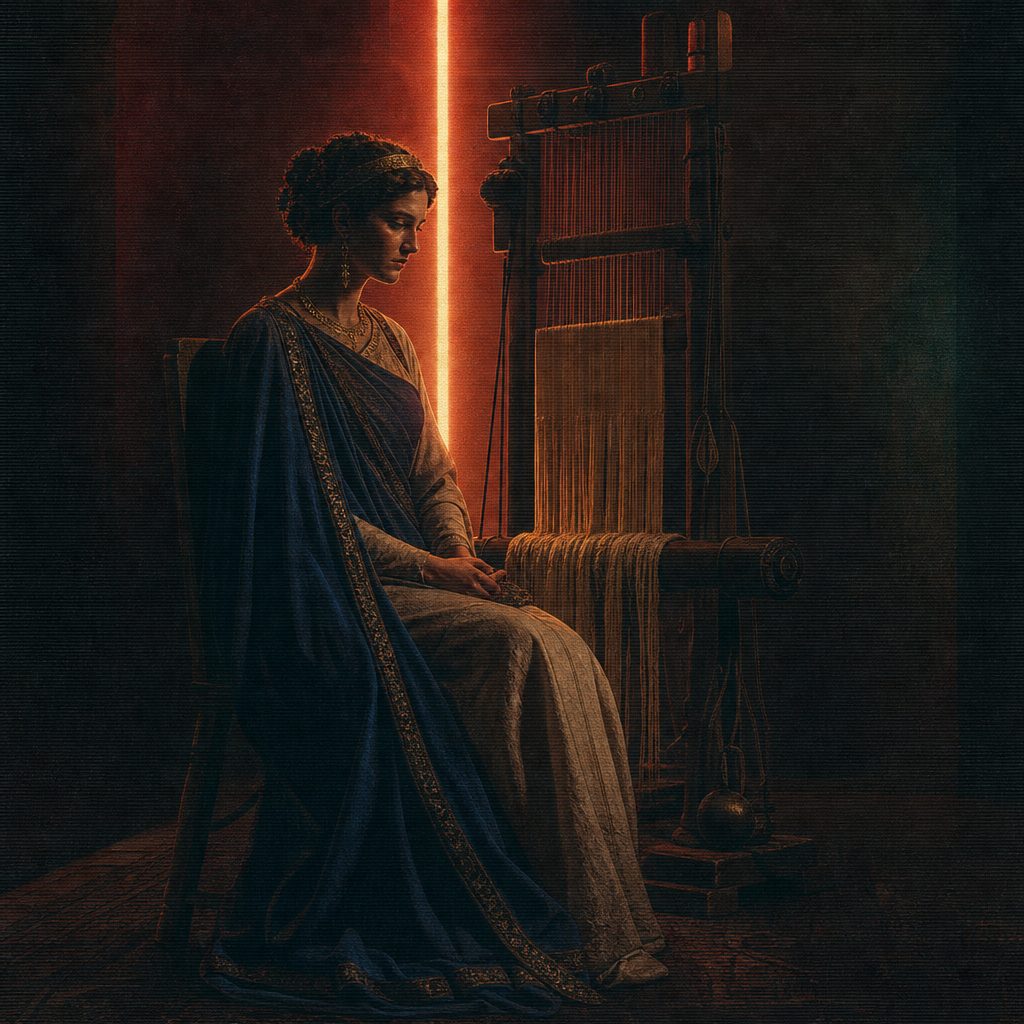
The old woman went upstairs chuckling with delight, to tell her mistress that her dear husband was home. Her knees moved briskly and her feet hurried over the steps. She stood above Penelope’s head and spoke. “Wake up, Penelope, dear child! See with your own eyes what you have longed for every day. Odysseus has come! Late though he is, he has reached his home. He has killed the proud suitors who plagued his house, ate his possessions and oppressed his son.” Thoughtful Penelope answered her. “Dear nurse, the gods have made you mad. They can make a fool of even the wisest person, and bring the thoughtless back to good sense. They have harmed you; before this your mind was sound. Why mock me when my heart has so much grief, telling me wild things and waking me from the sweet sleep that bound me, covering my eyelids? I have never slept like that since Odysseus went to see accursed Ilium, whose name I hate to speak. Go downstairs now and back into the hall. If any other woman of mine had come with such news and woken me from sleep, I would soon have sent her back to the hall in misery. Your old age will spare you that.”
Read Ancient Greek Source (Odyssey.23.1–Odyssey.23.24)
Her dear nurse Eurycleia answered her. “I’m not mocking you, dear child. Odysseus truly has come and reached his house, just as I say. He is the stranger everyone dishonored in the hall. Telemachus knew long ago that he was inside, but wisely kept his father’s plans hidden, so he could punish those overbearing men for their violence.” Penelope rejoiced. She sprang from bed and threw her arms around the old woman, tears falling from her eyelids. “Come, dear nurse, tell me truly. If he has really come home, as you say, how did he lay hands on the shameless suitors, alone as he was, while they always stayed gathered together inside?”
Read Ancient Greek Source (Odyssey.23.25–Odyssey.23.38)
Her dear nurse Eurycleia answered her. “I didn’t see it, didn’t learn how; I only heard them groaning as they were killed. We sat terrified deep in the well-built rooms, with the closely fitted doors shut, until your son Telemachus called me from the hall. His father had sent him to fetch me. Then I found Odysseus standing among the slain bodies. They lay all around him, piled on one another across the hard-packed ground. The sight would have warmed your heart. Now they are all in a heap by the courtyard gates, and he is cleansing the beautiful house with sulfur, having kindled a great fire. He sent me to call you. Come, so both your dear hearts can enter into joy, after all the suffering you have borne. That long desire has now been fulfilled. He himself has come alive to his hearth, and found you and his son in the house. All the suitors who treated him so badly he has punished in his own home.”
Read Ancient Greek Source (Odyssey.23.39–Odyssey.23.57)
Thoughtful Penelope answered her. “Dear nurse, don’t exult so loudly yet, laughing with delight. You know how welcome his appearance in the hall would be to everyone, and most of all to me and the son we bore. But this story cannot be true as you tell it. One of the immortals has killed the proud suitors, angry at their heart-breaking insolence and wicked deeds. They honored no mortal who came to them, neither bad nor good. That is why their reckless acts brought them harm. But Odysseus has lost his return, far from Achaean land, and has himself perished.”
Read Ancient Greek Source (Odyssey.23.58–Odyssey.23.68)
Her dear nurse Eurycleia answered her. “My child, what words have escaped the fence of your teeth? Your husband is inside, beside the hearth, and you say he will never come home. Your heart is always distrustful. Come, I’ll tell you another unmistakable sign: the scar where a boar once struck him with its white tusk. I noticed it as I washed him and wanted to tell you yourself. But he gripped me by the chin with his hands and would not let me speak, so much did his mind know. Come with me. I stake my own life: if I deceive you, kill me with the most pitiful death.” Thoughtful Penelope answered her. “Dear nurse, it is hard for you, knowledgeable though you are, to trace the plans of the gods who live forever. Still, let us go to my son, so I can see the suitors dead, and the man who killed them.”
Read Ancient Greek Source (Odyssey.23.69–Odyssey.23.84)
She came down from the upper rooms, turning many things over in her heart. Should she question her dear husband from a distance, or stand beside him, take his hands and kiss his head? When she entered and crossed the stone threshold, she sat opposite Odysseus in the firelight by the other wall. He sat beside a tall pillar, looking down, waiting to see whether his strong wife would say something when she had seen him with her own eyes. She sat silent a long time, amazement filling her heart. Sometimes she looked straight at his face; sometimes she could not recognize him in the wretched clothes he wore. Telemachus rebuked her. “Mother, cruel mother, with your hard heart! Why keep so far from Father? Why not sit beside him and speak, ask him questions? No other woman would harden her heart and stand so far from a husband who had come to his native land in the twentieth year after so much toil and suffering. Your heart is always harder than stone.”
Read Ancient Greek Source (Odyssey.23.85–Odyssey.23.103)
Thoughtful Penelope answered him. “My child, my heart is stunned within my breast. I cannot speak to him or question him, or look him straight in the face. But if this truly is Odysseus, come to his home, we two will know each other better than this. We have signs that we alone know, hidden from everyone else.” Steadfast, godlike Odysseus smiled and at once spoke to Telemachus. “Telemachus, let your mother test me in the hall. Soon she will understand better. Now, because I’m dirty and wear wretched clothes, she dishonors me and will not yet admit that I am he. But we must consider how things can turn out best. A man who kills even one person in his country, someone with few supporters left behind, goes into exile, leaving his relatives and native land. We have killed the city’s mainstay, the finest young men by far in Ithaca. I ask you to think of that.”
Read Ancient Greek Source (Odyssey.23.104–Odyssey.23.122)
Sensible Telemachus answered him. “Look to it yourself, dear Father. They say your cunning is the best among men; no other mortal could compete with you. We will follow you eagerly, and I say we will not lack courage, so far as our strength permits.” Odysseus, master of schemes, answered him. “Then I will tell you what seems best to me. First bathe and put on tunics, and tell the enslaved women in the hall to dress. Let the divine singer take his clear-toned lyre and lead us in a merry dance. Then anyone hearing from outside, a passerby on the road or one of our neighbors, will say it is a wedding. News of the suitors’ murder must not spread through the town before we have gone out to our tree-rich farm. There we will consider whatever advantage the Olympian puts into our hands.”
Read Ancient Greek Source (Odyssey.23.123–Odyssey.23.140)
They listened and obeyed him. First they bathed and put on tunics, and the women dressed themselves. The divine singer took his hollow lyre and stirred their desire for sweet song and fine dancing. The great house resounded beneath the feet of the dancing men and the women with lovely belts. Someone hearing from outside would say, “Surely someone has married the much-courted queen! Hard-hearted woman, she could not bring herself to guard her wedded husband’s great house to the end, until he returned.” So people spoke, not knowing what had happened.
Read Ancient Greek Source (Odyssey.23.141–Odyssey.23.152)
Eurynome the housekeeper bathed great-hearted Odysseus in his own house and anointed him with oil. She put a fine cloak and tunic around him. Athena poured great beauty over his head, making him taller and fuller to look at, and sent curling locks down from his head like the hyacinth flower. As a craftsman skilled in every art, taught by Hephaestus and Pallas Athena, pours gold over silver and makes beautiful works, so she poured grace over his head and shoulders. He stepped from the bath, like the immortals in form, and sat again on the chair from which he had risen, opposite his wife. “Strange woman, the gods who dwell on Olympus have given you a heart harder than that of any other woman. No other woman would harden herself and stand so far from a husband who had come to his native land in the twentieth year after so much toil and suffering. Come, nurse, spread a bed for me so I too can lie down. Her heart within her is iron.”
Read Ancient Greek Source (Odyssey.23.153–Odyssey.23.172)
Thoughtful Penelope answered him. “Strange man, I am neither proud nor scornful, nor am I lost in wonder. I know very well what you were like when you left Ithaca in the long-oared ship. Come, Eurycleia, spread his strong bed outside the well-built chamber he made himself. Put the strong bed out there and lay bedding on it, fleeces, cloaks and shining coverlets.”
Read Ancient Greek Source (Odyssey.23.173–Odyssey.23.180)
So she spoke, testing her husband. In vexation Odysseus addressed his faithful wife. “Woman, those words you have spoken cut deep. Who has moved my bed elsewhere? It would be hard for even a highly skilled man, unless a god came himself and easily set it in another place if he wished. No living mortal, not even a man in his prime, could shift it easily. There is a great sign worked into that carefully made bed. I made it myself, no one else. A long-leafed olive tree grew inside the enclosure, strong and flourishing, its trunk as thick as a pillar. Around it I built the bedroom, completing it with closely set stones, roofing it well above and fitting tightly joined doors. Then I cut the crown from the long-leafed olive and trimmed the trunk up from the root, smoothing it all around with bronze, carefully and well, straightening it to a line. I fashioned it into a bedpost and bored it through with an auger. Beginning with that, I shaped the bed until it was finished, adorning it with gold, silver and ivory. Across it I stretched an oxhide strap bright with purple. That is the sign I tell you. But I don’t know, woman, whether my bed is still fixed in place, or some man has cut through the olive trunk at the base and moved it elsewhere.”
Read Ancient Greek Source (Odyssey.23.181–Odyssey.23.204)
Her knees and dear heart gave way as she recognized the sure signs Odysseus had described. Weeping, she ran straight to him, threw her arms around his neck, kissed his head and said, “Odysseus, don’t be angry with me. In everything else you have more understanding than any man. The gods gave us misery; they begrudged us the chance to stay together and enjoy our youth and reach the threshold of old age. Don’t be angry or resentful now because I did not welcome you like this the instant I saw you. My heart always trembled lest some mortal come and deceive me with words. Many men devise wicked ways to profit. Argive Helen, Zeus’ daughter, would never have lain in love and bed with a man from another land if she had known the warlike sons of the Achaeans would bring her home again to her own country. A god drove her to do that shameful deed. She had not harbored that grievous blindness in her heart before, the blindness from which grief first came to us as well.
Read Ancient Greek Source (Odyssey.23.205–Odyssey.23.224)
“But now you have clearly told the signs of our bed, which no other mortal had seen, only you and I and a single attendant, Actoris, whom my father gave me when I came here, and who guarded the doors of our strong chamber. Now you convince my heart, hard though it was.” Her words stirred in him a still greater longing to weep. He wept, holding his beloved, faithful wife. As land appears welcome to swimmers whose well-made ship Poseidon has shattered at sea, driven by wind and solid waves, and a few escape the gray sea to the shore, swimming, their skin thick with crusted salt, and gladly step on land, safe from misery—so welcome was her husband as she looked at him. Her white arms would not yet wholly release his neck.
Read Ancient Greek Source (Odyssey.23.225–Odyssey.23.240)
Rosy-fingered Dawn would have appeared upon their weeping if gray-eyed Athena had not thought of something else. She held the long night at its farthest edge and kept golden-throned Dawn at Ocean, not letting her harness the swift-footed horses that bring light to men, Lampus and Phaethon, the colts that draw Dawn. Then Odysseus, master of schemes, spoke to his wife. “Wife, we have not yet come to the end of all our trials. There is still measureless toil ahead, long and hard, which I must carry through. So the spirit of Tiresias foretold to me on the day I went down into the house of Hades, seeking a homecoming for my companions and myself. But come, wife, let us go to bed, so we can lie down at last and take our pleasure in sweet sleep.” Thoughtful Penelope answered him. “Your bed will be ready whenever your heart wishes, since the gods have brought you to your well-built house and native land. But since you have thought of it and a god has put it in your mind, tell me the trial. I think I will learn of it later anyway, and it is no worse to know at once.”
Read Ancient Greek Source (Odyssey.23.241–Odyssey.23.262)
Odysseus, master of schemes, answered her. “Strange woman, why press me so hard to tell it? Still, I will speak and hide nothing. Your heart will find no joy in it; neither do I. He told me to go through very many cities of men, carrying a well-shaped oar in my hands, until I reach people who know nothing of the sea and do not mix salt with their food. They know nothing of ships with crimson-painted bows, or well-shaped oars, which are the wings of ships. He gave me this unmistakable sign, and I will not hide it from you: when another traveler meets me and says I carry a winnowing fan on my shining shoulder, then he told me to plant the oar in the ground and offer fine sacrifices to lord Poseidon, a ram, a bull and a boar that mates with sows. Then I must return home and offer sacred hundred-beast sacrifices to the immortal gods who hold the wide heaven, all of them in order. Death will come to me from the sea, a very gentle death, and kill me when I am worn out by a prosperous old age, with a happy people around me. He told me all these things would come to pass.”
Read Ancient Greek Source (Odyssey.23.263–Odyssey.23.284)
Thoughtful Penelope answered him. “If the gods will truly bring about a better old age, then you can hope for escape from your troubles.” While they spoke to one another, Eurynome and the nurse prepared the bed with soft bedding in the light of blazing torches. When they had busily spread the strong bed, the old woman went back to her rooms to sleep. Eurynome, the chamber attendant, led them to bed, holding a torch in her hands. Once she had brought them to the chamber, she went back. Gladly they returned to their old marriage bed. Telemachus, the cattle keeper and the swineherd stopped their dancing feet and stopped the women too. Then they lay down to sleep through the shadowy hall.
Read Ancient Greek Source (Odyssey.23.285–Odyssey.23.299)
When the two had enjoyed their lovely lovemaking, they delighted in stories, telling one another all that had happened. She, that radiant woman, told what she had endured in the house, watching the destructive crowd of suitors slaughtering so many cattle and fat sheep for her sake, and drawing so much wine from the jars. Odysseus, sprung from Zeus, told all the grief he had brought on others and all the misery he himself had toiled through. She delighted in listening, and sleep did not fall upon her eyelids until he had told it all. He began with how he first overcame the Cicones and then reached the rich land of the Lotus-Eaters; what the Cyclops did, and how he made him pay for the strong companions he devoured without pity; how he reached Aeolus, who welcomed him warmly and sent him on, though it was not yet his fate to reach his native land, and a storm snatched him back and carried him groaning heavily over the fish-filled sea; how he reached Telepylus of the Laestrygonians, who destroyed his ships and all his companions in fine leg armor, while Odysseus alone escaped in his black ship.
Read Ancient Greek Source (Odyssey.23.300–Odyssey.23.320)
He told of Circe’s trick and many devices, and how he went in his many-benched ship to the dank house of Hades to consult the spirit of Theban Tiresias. There he saw all his companions and the mother who bore him and raised him as a little child. He told how he heard the voice of the clear-singing Sirens; how he reached the Wandering Rocks and terrible Charybdis and Scylla, whom men had never yet escaped unharmed; how his companions killed the Sun’s cattle; how Zeus who thunders on high struck his swift ship with a smoking thunderbolt, and all his noble companions perished together, while he himself escaped the evil powers of death. He told how he reached the island Ogygia and the nymph Calypso, who kept him in her hollow caves, longing for him to be her husband. She tended him and promised to make him immortal and ageless for all time, but could never persuade the heart within his breast. He told how, after much toil, he reached the Phaeacians, who honored him in their hearts like a god and sent him in a ship to his native land, giving him bronze and gold and clothing in abundance. That was the last thing he told when sweet sleep, loosening his limbs, rushed upon him and released his heart from care.
Read Ancient Greek Source (Odyssey.23.321–Odyssey.23.343)
Then gray-eyed Athena thought of something else. When she judged in her heart that Odysseus had had his fill of his wife’s bed and of sleep, she at once roused early-born Dawn on her golden throne from Ocean, to bring light to people. Odysseus rose from the soft bed and gave his wife instructions. “Wife, by now we have both had our fill of many trials. You were here weeping for my sorrowful homecoming, while Zeus and the other gods held me far from my native land with suffering, eager though I was to return. Now that we have both reached our longed-for bed, look after the possessions I still have in the hall. As for the livestock the overbearing suitors wasted, I will raid for many animals myself, and the Achaeans will give others until all the pens are full. I am going to the tree-rich farm to see my good father, who grieves deeply for me. But wife, wise though you are, I give you these instructions: with sunrise the news will spread about the suitors I killed in the hall. Go up to your upper room with your women attendants and stay there. Don’t look out at anyone or ask questions.”
Read Ancient Greek Source (Odyssey.23.344–Odyssey.23.365)
He put his fine armor around his shoulders and roused Telemachus, the cattle keeper and the swineherd, telling them all to take their weapons of war in their hands. They obeyed him and armed themselves in bronze. They opened the doors and went out, with Odysseus leading. It was already light on the earth, but Athena wrapped them in night and quickly led them out of the city.