Book 15: Telemachus Returns to Ithaca
Ὀδύσσεια · Book 15 · Classix Modern English Reading Edition
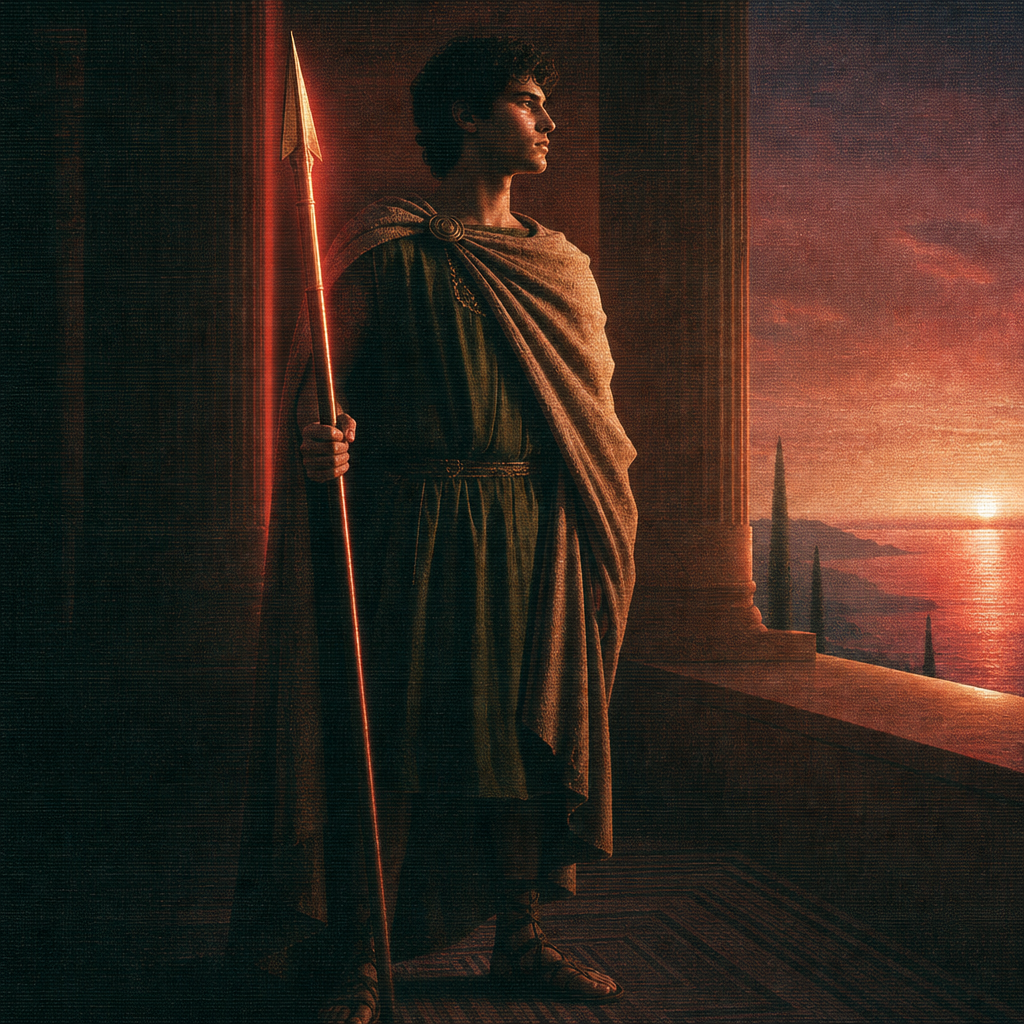
Pallas Athena went to spacious Lacedaemon to remind great-hearted Odysseus’s glorious son of home and urge him to return. She found Telemachus and Nestor’s splendid son lying in the porch of renowned Menelaus. Nestor’s son was overcome by gentle sleep, but sweet sleep did not hold Telemachus. All through the immortal night, cares for his father kept his heart awake. Bright-eyed Athena stood close and said: “Telemachus, it is no longer wise to wander far from home, leaving your possessions and such arrogant men in your house. They may divide and devour everything, making your journey useless. Urge Menelaus, good at the battle cry, to send you home at once, so that you may still find your excellent mother there.
Read Ancient Greek Source (Odyssey.15.1–Odyssey.15.15)
“Already her father and brothers are pressing her to marry Eurymachus. He outdoes all the suitors in gifts and has increased his marriage offerings. Do not let her take possessions from your house against your will. You know what a woman’s heart is like: she wants to enrich the house of the man who marries her, and no longer remembers or asks about her former children or the dear husband of her youth once he is dead. Go home yourself and entrust everything to whichever enslaved woman seems best to you, until the gods show you a glorious wife.
Read Ancient Greek Source (Odyssey.15.16–Odyssey.15.26)
“I will tell you something else; take it to heart. The best of the suitors are deliberately lying in wait for you in the strait between Ithaca and rocky Samos, eager to kill you before you reach your own country. But I do not think they will. The earth will cover some of those suitors who eat up your livelihood before that happens. Keep your well-built ship far from the islands and sail through the night as well. The immortal who guards and protects you will send a following wind. When you reach the first headland of Ithaca, send the ship and all your companions to town. Go yourself first to the swineherd who guards your pigs and is still loyal to you. Spend the night there, and send him into town to tell thoughtful Penelope that you are safe and have returned from Pylos.”
Read Ancient Greek Source (Odyssey.15.27–Odyssey.15.42)
She went away to high Olympus. Telemachus roused Nestor’s son from sweet sleep, nudging him with his foot, and said: “Wake up, Peisistratus, son of Nestor! Bring the solid-hoofed horses and harness them to the chariot, so we can get on our way.” Peisistratus answered: “Telemachus, however eager we are to travel, we cannot drive through the dark night. Dawn will be here soon. Wait until the warrior Menelaus, son of Atreus, famed for his spear, brings gifts to put in the chariot and sends us off with gentle words. A guest remembers all his days the host who treats him with affection.” At once Dawn of the golden throne arrived. Menelaus, good at the battle cry, came near them, rising from bed beside lovely-haired Helen.
Read Ancient Greek Source (Odyssey.15.43–Odyssey.15.58)
As soon as Odysseus’s dear son saw him, the young warrior hurriedly put on his shining tunic, threw a great cloak about his sturdy shoulders, and went outside. Standing beside him, Telemachus, dear son of godlike Odysseus, said: “Menelaus, son of Atreus, nurtured by Zeus, leader of the people, send me to my own country now. My heart is longing to get home.” Menelaus, good at the battle cry, answered: “Telemachus, I will not keep you here long when you long to return. I resent another host who is excessive either in affection or in hostility. Moderation is better in everything. It is equally wrong to hurry away a guest who does not want to go and to detain one eager to leave. Welcome the guest while he is here, and send him off when he wishes. But stay until I bring fine gifts and put them in the chariot for you to see, and tell the women to prepare a meal in the hall from our abundant stores. It brings honor, splendor, and benefit to dine before traveling far over the boundless earth.
Read Ancient Greek Source (Odyssey.15.59–Odyssey.15.79)
“If you wish to turn aside through Hellas and the heart of Argos, I will go with you, harness horses, and lead you through the cities. No one will send us off empty-handed. Each will give something to carry away: a fine bronze tripod or cauldron, a pair of mules, or a golden cup.” Sensible Telemachus answered: “Menelaus, son of Atreus, nurtured by Zeus, leader of the people, I want to go home now. I left no guard over my possessions when I came away. While seeking my godlike father, I may perish myself, or some fine treasure may be lost from my house.” When Menelaus heard that, he immediately told his wife and the enslaved women to prepare a meal in the hall from their abundant stores. Eteoneus, son of Boethous, rose from bed and came near; he lived close by. Menelaus, good at the battle cry, told him to light a fire and roast meat. He heard and obeyed.
Read Ancient Greek Source (Odyssey.15.80–Odyssey.15.98)
Menelaus himself went down to his fragrant storeroom. He did not go alone: Helen and Megapenthes went with him. When they reached the treasures, the son of Atreus took a two-handled cup and told his son Megapenthes to carry a silver mixing bowl. Helen stood beside the chests holding the richly patterned robes she had made herself. That radiant woman lifted one out and carried it, the largest and loveliest in its embroidery. It shone like a star and lay beneath the others. They went on through the house until they reached Telemachus. Golden-haired Menelaus said: “Telemachus, may Zeus, Hera’s loud-thundering husband, fulfill your homecoming just as you desire. Of all the treasures stored in my house, I will give you the finest and most precious: a crafted mixing bowl, all silver, with a rim finished in gold. It is Hephaestus’s work. The warrior Phaedimus, king of the Sidonians, gave it to me when his house sheltered me on my way home. I want to give it to you.”
Read Ancient Greek Source (Odyssey.15.99–Odyssey.15.119)
The warrior son of Atreus put the two-handled cup in his hands. Strong Megapenthes brought the shining silver mixing bowl and set it before him. Lovely-cheeked Helen stood nearby, holding the robe, and said: “Dear child, I give you this gift too, a remembrance of Helen’s hands, for your wife to wear when the much-desired time of your wedding comes. Until then, let it lie with your dear mother in the hall. May you reach your well-built home and your native land with joy.” She put it in his hands, and he took it gladly. The warrior Peisistratus received the gifts and stowed them in the chariot’s basket, marveling in his heart at them all.
Read Ancient Greek Source (Odyssey.15.120–Odyssey.15.132)
Golden-haired Menelaus led them into the hall, where they sat on chairs and seats. An attendant brought water in a lovely golden pitcher and poured it over a silver basin for them to wash their hands, then drew a polished table beside them. The respected housekeeper brought bread and set out many foods, giving freely from the stores. Boethous’s son carved the meat and distributed the portions, while renowned Menelaus’s son poured wine. They reached for the good food set before them. When they had satisfied their desire for food and drink, Telemachus and Nestor’s splendid son harnessed the horses, mounted the decorated chariot, and drove out through the gateway and echoing porch. Golden-haired Menelaus, son of Atreus, followed, holding honey-sweet wine in a golden cup in his right hand, so they could pour an offering before leaving. He stood before the horses and greeted them: “Fare well, young men. Give my greetings to Nestor, shepherd of the people. He was kind to me as a father while we sons of the Achaeans fought at Troy.” Sensible Telemachus answered: “Nurtured by Zeus, when we reach him we will certainly tell him all you say. If only I could reach Ithaca too, find Odysseus in the house, and tell him I have come from you, having met with every kindness and bringing many fine treasures!”
Read Ancient Greek Source (Odyssey.15.133–Odyssey.15.159)
As he spoke, a bird flew past on their right: an eagle carrying in its talons a huge white goose, tame, from a farmyard. Men and women followed shouting. It came close and swept to the right in front of the horses. They rejoiced at the sight, and every heart grew warm. Peisistratus, son of Nestor, spoke first: “Menelaus, nurtured by Zeus, leader of the people, consider: did a god show this sign to the two of us or to you?” Menelaus, dear to Ares, pondered how to understand and answer him properly. But Helen in her flowing robe spoke before him: “Listen to me. I will prophesy as the immortals put it in my heart, and as I think it will happen. Just as this eagle came from the mountain where it was born and bred and snatched a goose reared in the house, so Odysseus, after much suffering and wandering, will return home and take revenge. Or perhaps he is already at home, planting trouble for all the suitors.”
Read Ancient Greek Source (Odyssey.15.160–Odyssey.15.178)
Sensible Telemachus answered: “May Zeus, Hera’s loud-thundering husband, bring it about! Then I would pray to you like a goddess even there at home.” He struck the horses with the whip. Eagerly they sped through the city toward the plain. All day they shook the yoke they bore between them. The sun went down, and every road grew dark. They reached Pherae and the house of Diocles, son of Ortilochus, whose father was Alpheus. They spent the night there, and he set hospitality before them. When early-born, rosy-fingered Dawn appeared, they harnessed the horses, mounted the decorated chariot, and drove out through the gateway and echoing porch. Peisistratus whipped them on, and the pair flew willingly. Soon they reached the high stronghold of Pylos.
Read Ancient Greek Source (Odyssey.15.179–Odyssey.15.193)
Then Telemachus said to Nestor’s son: “Son of Nestor, would you promise to do what I ask? We claim to be guest-friends forever through our fathers’ friendship, and we are the same age. This journey will bring us still closer in understanding. Do not take me past the ship. Leave me there, nurtured by Zeus, so the old man does not keep me in his house against my will, eager to show his kindness. I need to get home quickly.” Nestor’s son considered how to promise and fulfill his request properly. This seemed the better course: he turned the horses toward the swift ship and the seashore, unloaded the fine gifts of clothing and gold that Menelaus had given Telemachus into the stern, and urged him with winged words: “Hurry aboard now and order all your companions aboard before I get home and tell the old man. I know well in my mind and heart how overbearing his spirit is. He will not let you go. He will come here himself to summon you, and I do not think he will go back empty-handed. He will be very angry.”
Read Ancient Greek Source (Odyssey.15.194–Odyssey.15.214)
He drove the lovely-maned horses back to the Pylian city and quickly reached the house. Telemachus urged his companions: “Stow the gear in the black ship, friends. Let us board and get on our way.” They listened and obeyed, boarding quickly and sitting at the oarlocks. While he attended to this, he prayed and offered sacrifice to Athena beside the ship’s stern. A man from far away came near, a seer fleeing Argos after killing a man. He was descended from Melampus, who once lived in Pylos, mother of flocks, a rich man in a house far finer than those of the other Pylians. But he had since gone to another people’s land, leaving his country and great-hearted Neleus, proudest of living men. For a full year Neleus had forcibly held his great possessions, while Melampus lay in cruel bonds in Phylacus’s house, suffering terribly for Neleus’s daughter and for the heavy delusion the goddess, the fierce Fury, had put in his mind.
Read Ancient Greek Source (Odyssey.15.215–Odyssey.15.234)
But Melampus escaped his doom, drove the loud-lowing cattle from Phylace to Pylos, and made godlike Neleus pay for his shameful deed. He brought the woman home as a wife for his brother. He himself went to another people’s country, horse-grazing Argos. There he was fated to live and rule many Argives. There he married, built a high-roofed house, and fathered two mighty sons, Antiphates and Mantius. Antiphates fathered great-hearted Oicles, and Oicles fathered Amphiaraus, who roused armies. Aegis-bearing Zeus and Apollo loved him deeply, with every kind of affection. But he never reached the threshold of old age: he perished at Thebes because of gifts to a woman. His sons were Alcmaeon and Amphilochus. Mantius in turn fathered Polypheides and Cleitus. Dawn of the golden throne snatched Cleitus away for his beauty, so he might live among the immortals. Apollo made proud Polypheides the best seer of all mortals after Amphiaraus died. Angry with his father, he moved to Hyperesia and lived there, prophesying for all men.
Read Ancient Greek Source (Odyssey.15.235–Odyssey.15.255)
His son had now come near, a man named Theoclymenus. He stood beside Telemachus and found him pouring an offering and praying beside the swift black ship. He spoke these winged words: “Friend, since I find you sacrificing here, I beg you by your offerings and your god, then by your own life and the companions who follow you: tell me the truth when I ask, and hide nothing. Who are you, and where do you come from? Where are your town and parents?” Sensible Telemachus answered: “Stranger, I will tell you plainly. I come from Ithaca, and my father is Odysseus—if ever he was! By now he has perished in a miserable death. That is why I have taken companions and a black ship and come to ask about my long-absent father.”
Read Ancient Greek Source (Odyssey.15.256–Odyssey.15.270)
Godlike Theoclymenus said: “I too am away from my country, because I killed a man of my own kin. He has many brothers and kinsmen in horse-grazing Argos, and they hold great power among the Achaeans. To escape death and black doom at their hands, I am in flight. It is my fate to wander among men. Take me aboard your ship, since I have come to you as a fugitive suppliant, so they do not kill me. I think they are pursuing me.” Sensible Telemachus answered: “I will not drive you from my balanced ship if you wish to come. Follow me. At home we will welcome you with whatever we have.” He took the bronze spear from him and laid it along the curved ship’s deck. Then he too boarded the seagoing ship. He sat in the stern and seated Theoclymenus beside him. The men loosed the stern cables.
Read Ancient Greek Source (Odyssey.15.271–Odyssey.15.286)
Telemachus urged his companions to work the gear. They hurried to obey, raised the fir mast, set it in the socket of the hollow crossbeam, and secured it with forestays. They hauled up the white sails with twisted oxhide ropes. Bright-eyed Athena sent them a following wind, blowing fiercely through the clear sky so that the ship could race across the salt water as quickly as possible. They passed Crouni and fair-flowing Chalcis. The sun went down, and every road grew dark. Driven by Zeus’s following wind, she made for Pheae and passed holy Elis, where the Epeians rule. From there Telemachus set her toward the pointed islands, wondering whether he would escape death or be caught.
Read Ancient Greek Source (Odyssey.15.287–Odyssey.15.300)
Meanwhile Odysseus and the noble swineherd ate supper in the hut, with the other men eating beside them. When they had satisfied their desire for food and drink, Odysseus spoke, testing whether the swineherd would still welcome him kindly and tell him to stay at the farm, or urge him toward town: “Listen, Eumaeus, and all you other companions. At dawn I mean to go to town and beg, so I will not wear you and your companions out. Give me good advice and a good guide to take me there. Necessity will make me wander about the city, hoping someone will hand me a cup of drink and a piece of bread. I could go to godlike Odysseus’s house and give news to thoughtful Penelope. I could mingle with the arrogant suitors and see whether they would give me supper from their countless good things. I could quickly do whatever work they wanted. I will tell you plainly; take it to heart and listen. Thanks to Hermes the messenger, who gives grace and glory to all men’s work, no mortal could compete with me in serving: building up a fire, splitting dry wood, carving, roasting, and pouring wine, the things lesser men do for their betters.”
Read Ancient Greek Source (Odyssey.15.301–Odyssey.15.324)
Deeply troubled, you answered him, Eumaeus the swineherd: “Ah, stranger, why has this thought come into your mind? You must long to perish there, if you want to enter the crowd of suitors whose outrage and violence reach the iron sky! Their servants are nothing like you. Young men serve them, well dressed in cloaks and tunics, their heads and handsome faces always shining with oil. Their polished tables groan with bread and meat and wine. Stay here. No one is troubled by your presence, neither I nor any of my companions. When Odysseus’s dear son comes, he will give you a cloak and tunic to wear and send you wherever your heart and spirit urge.”
Read Ancient Greek Source (Odyssey.15.325–Odyssey.15.339)
Long-suffering noble Odysseus answered: “Eumaeus, may father Zeus love you as I do, since you have stopped my wandering and terrible misery. Nothing is worse for mortals than a wandering life. It is for the sake of the accursed belly that men suffer bitter cares when wandering, trouble, and pain come upon them. Now that you hold me back and tell me to wait for him, tell me about godlike Odysseus’s mother and his father, whom he left on the threshold of old age when he went away. Are they still alive beneath the sunlight, or are they dead now in the house of Hades?”
Read Ancient Greek Source (Odyssey.15.340–Odyssey.15.350)
The swineherd, leader of men, said: “Stranger, I will tell you plainly. Laertes is still alive, but he constantly prays to Zeus that life may leave his limbs in his own house. He grieves terribly for his absent son and for his wise wedded wife. Her death hurt him most of all and put him into raw old age. She died of grief for her glorious son, a wretched death. May no one who lives here as my friend and does me kindness ever die like that! While she lived, grieving though she was, I still took pleasure in asking and inquiring, because she herself had raised me with Ctimene in her flowing robe, her noble daughter, the youngest child she bore. I grew up beside Ctimene, and her mother honored me only a little less than her. When we both reached lovely youth, they married Ctimene to a man on Same and received countless gifts. Odysseus’s mother dressed me in a beautiful cloak and tunic, gave me sandals for my feet, and sent me to the farm. She loved me all the more in her heart.
Read Ancient Greek Source (Odyssey.15.351–Odyssey.15.370)
“Now I lack those things. But the blessed gods make the work I keep at prosper for me. From it I have food and drink and something to give to those I respect. From my mistress now I can hear no gentle word or receive a kindly deed, since evil fell upon the house: the arrogant men. Enslaved people long to speak face to face with their mistress and ask about everything, to eat and drink, then take something back to the farm, the things that always warm their hearts.”
Read Ancient Greek Source (Odyssey.15.371–Odyssey.15.379)
Resourceful Odysseus answered: “Ah, Eumaeus the swineherd, how far you were driven from your own land and parents while still a little child! Tell me this plainly: was the broad-streeted city where your father and honored mother lived sacked? Or did hostile men catch you alone with sheep or cattle, carry you away in ships, and sell you to this man’s house, where he paid a proper price?” The swineherd, leader of men, answered: “Stranger, since you ask and inquire about this, sit quietly, listen with pleasure, and drink your wine. These nights are immensely long. There is time for sleep and time to enjoy listening. You need not lie down before the hour. Too much sleep is tiresome too. Any of the others whose heart and spirit urge him can go out and sleep. At dawn he can eat and go with our master’s pigs. The two of us will drink and feast in the hut, taking pleasure in remembering each other’s wretched sorrows. Afterward a man can find pleasure even in pain, when he has suffered much and wandered far. I will tell you what you ask.
Read Ancient Greek Source (Odyssey.15.380–Odyssey.15.402)
“There is an island called Syrie—you may have heard of it—beyond Ortygia, where the Sun turns. It is not so very populous, but it is a good land, rich in pasture and sheep, full of wine and wheat. Hunger never enters its people’s land, nor any other hateful sickness that troubles wretched mortals. When the generations of men in the city grow old, Apollo of the silver bow comes with Artemis and kills them with his gentle arrows. There are two cities there, and everything is divided between them. My father ruled both, Ctesius, son of Ormenus, a man like the immortals.
Read Ancient Greek Source (Odyssey.15.403–Odyssey.15.414)
“Phoenician men famed for their ships came there, greedy traders bringing countless trinkets in a black ship. In my father’s house was a Phoenician woman, beautiful and tall, skilled in splendid handiwork. The very cunning Phoenicians deceived her. One of them first lay with her in love beside the hollow ship as she was washing clothes—things that deceive women’s minds, even a woman who does good. Then he asked who she was and where she came from. She immediately described her father’s high-roofed house: ‘I claim to come from Sidon, rich in bronze. I am the daughter of Arybas, a man of overflowing wealth. But Taphian raiders snatched me as I came from the fields. They brought me here and sold me to this man’s house. He paid a proper price.’
Read Ancient Greek Source (Odyssey.15.415–Odyssey.15.429)
“The man who lay with her in secret said: ‘Would you now come home again with us, so you can see your father and mother and their high-roofed house? They are still alive and are called rich.’ The woman answered: ‘That could happen, sailors, if you are willing to swear an oath to take me home unharmed.’ They all swore as she asked. When they had sworn and completed the oath, the woman said: ‘Silence now. Let none of your companions speak to me when he meets me in the street or at the spring. Someone might go and tell the old man in the house. He would grow suspicious, bind me in cruel bonds, and plan your destruction. Keep this in mind, and hurry to buy your cargo for the voyage. When your ship is full of goods, send word to me quickly at the house. I will bring whatever gold comes into my hands. And I would gladly give you something else to pay my passage. I am raising a good man’s child in the house, a clever little boy who runs outside beside me. I could bring him to your ship, and he would fetch you an immense price wherever you sold him among people of foreign tongues.’
Read Ancient Greek Source (Odyssey.15.430–Odyssey.15.453)
“She went back to the fine house. They stayed with us a whole year, trading and gathering many goods into their hollow ship. When the ship was loaded for their return, they sent a messenger to tell the woman. A knowing man came to my father’s house with a golden necklace strung with amber beads between. In the hall the enslaved women and my honored mother handled it and gazed at it, offering a price, while he nodded silently to the woman. After his nod he went back to the hollow ship. She took me by the hand and led me out of the house. In the porch she found cups and tables belonging to the men who feasted in attendance on my father. They had gone out to the council and the people’s debate. She quickly hid three cups in the folds of her dress and carried them away. I followed in my childish folly. The sun went down, and every road grew dark. We hurried to the famous harbor, where the Phoenicians’ sea-swift ship lay. They boarded and sailed the watery paths, taking the two of us aboard. Zeus sent a following wind.
Read Ancient Greek Source (Odyssey.15.454–Odyssey.15.475)
“For six days we sailed, night and day alike. When Zeus, son of Cronus, brought the seventh day, Artemis the archer struck the woman. She fell with a thud into the bilge like a seabird. They threw her overboard to become food for seals and fish. I was left behind, grieving at heart. Wind and water carried them to Ithaca, where Laertes bought me with his possessions. That is how I first saw this land with my own eyes.” Odysseus, descended from Zeus, answered: “Eumaeus, you have truly stirred the heart in my breast by telling all the sorrows you suffered. Yet alongside the evil Zeus gave you something good: after much suffering you reached the house of a kind man, who willingly gives you food and drink, and you live a good life. I have come here only after wandering through many cities of mortals.”
Read Ancient Greek Source (Odyssey.15.476–Odyssey.15.492)
So they talked, then lay down to sleep, not for long, but only a little while, for Dawn of the lovely throne soon arrived. Meanwhile near the shore Telemachus’s companions loosed the sails, quickly lowered the mast, and rowed the ship into her anchorage. They threw out anchor stones, fastened the stern cables, went ashore, and prepared a meal beside the sea, mixing gleaming wine. When they had satisfied their desire for food and drink, sensible Telemachus spoke first: “Now row the black ship to town. I will visit the fields and herdsmen myself. When I have seen my farms, I will come down to town at evening. At dawn I could set before you a reward for the journey, a good feast of meat and sweet-drinking wine.”
Read Ancient Greek Source (Odyssey.15.493–Odyssey.15.507)
Godlike Theoclymenus said: “Where should I go, dear child? To whose house among the men who rule rocky Ithaca? Or should I go straight to your mother and your home?” Sensible Telemachus answered: “In other circumstances I would tell you to come to our house. You would lack no hospitality. But it would be worse for you yourself, since I will be away and my mother will not see you. She does not often appear among the suitors in the hall; she stays apart from them and weaves at her loom upstairs. But I will name another man you could go to: Eurymachus, splendid son of wise Polybus, whom the Ithacans now look upon as a god. He is by far the best man and most eager to marry my mother and hold Odysseus’s place of honor. But Zeus of Olympus, who lives in the clear sky, knows whether he will bring an evil day upon them before the wedding.”
Read Ancient Greek Source (Odyssey.15.508–Odyssey.15.524)
As he spoke, a bird flew past on his right: a hawk, Apollo’s swift messenger. It held a dove in its talons and tore at it, scattering feathers to earth between the ship and Telemachus himself. Theoclymenus called him away from his companions, clasped his hand, and said: “Telemachus, that bird did not fly past on your right without a god’s will. I recognized it as an omen when I looked straight at it. There is no family more kingly than yours in the land of Ithaca. Yours will always be powerful.” Sensible Telemachus answered: “Stranger, if only your words would come true! You would soon know such kindness and so many gifts from me that anyone who met you would call you fortunate.”
Read Ancient Greek Source (Odyssey.15.525–Odyssey.15.538)
Then he spoke to his trusty companion Peiraeus: “Peiraeus, son of Clytius, of all the companions who followed me to Pylos, you are the most willing to do as I ask in everything. Now take this stranger to your house, welcome him kindly, and honor him until I come.” Peiraeus, famed for his spear, answered: “Telemachus, even if you stay here a long time, I will care for him. He will lack no hospitality.” He boarded the ship and told his companions to board too and loose the stern cables. They boarded quickly and sat at the oarlocks. Telemachus tied his fine sandals under his feet and took his sturdy spear, tipped with sharp bronze, from the ship’s deck. They loosed the stern cables, pushed off, and sailed for town as Telemachus, dear son of godlike Odysseus, had ordered. His feet carried him swiftly forward until he reached the yard where his countless pigs lived, and where the good swineherd slept, loyal to his masters.