Book 9: The Cicones, Lotus-Eaters, and Polyphemus the Cyclops
Ὀδύσσεια · Book 9 · Classix Modern English Reading Edition
Resourceful Odysseus answered him: “Lord Alcinous, most distinguished of all your people, it is a fine thing to hear a singer like this, with a voice like the gods’. I know no more delightful fulfillment than joy throughout a whole community, with guests sitting in rows in the halls to listen to a singer, tables heaped with bread and meat beside them, and a wine-pourer drawing wine from the bowl, carrying it round and filling their cups. To my mind that is the finest thing of all.
Read Ancient Greek Source (Odyssey.9.1–Odyssey.9.11)
“But your heart has turned to asking about my sorrowful troubles, so I must grieve and groan still more. What should I tell you first, what last? The heavenly gods have given me so many sorrows. First I will tell you my name, so you too may know, and I may be your guest-friend after I escape this pitiless time, even though my house is far away. I am Odysseus, son of Laertes, known to everyone for my stratagems, and my fame reaches heaven. I live in clear-seen Ithaca. On it stands Neriton, conspicuous with its trembling leaves. Many islands lie close around it, Dulichium, Same and wooded Zacynthus. Ithaca itself lies low, farthest out in the sea toward the darkness of the west; the others lie apart toward the dawn and sun. It is rugged, but a good nurse of young men. I can see nothing sweeter than my own land.
Read Ancient Greek Source (Odyssey.9.12–Odyssey.9.28)
“Calypso, shining among goddesses, kept me in her hollow caves, longing for me to be her husband. So too cunning Circe of Aeaea held me back in her halls, longing for me to be her husband. But neither ever persuaded my heart. Nothing is sweeter than a man’s own land and parents, even if he lives in a rich house far away in a foreign country, apart from his parents. Now I will tell you of the sorrowful return Zeus imposed on me when I left Troy.
Read Ancient Greek Source (Odyssey.9.29–Odyssey.9.38)
“The wind carried me from Ilium to the Cicones at Ismarus. I sacked the city and killed its men. We took their wives and much wealth from the city and divided them, so no one would be cheated of an equal share. Then I ordered us to flee at once, but the fools would not obey. They drank much wine and slaughtered many sheep and shambling, curved-horned cattle beside the shore. Meanwhile the Cicones who escaped called to their neighbors, more numerous and better fighters, living inland. They knew how to fight from chariots, and on foot when they needed to.
Read Ancient Greek Source (Odyssey.9.39–Odyssey.9.50)
“At dawn they came in numbers like the leaves and flowers of spring. Then an evil fate from Zeus stood beside us, doomed men, to bring us many sorrows. They drew up beside the swift ships and fought us, and we hurled bronze-tipped spears at one another. Through the morning, as the sacred day grew, we held our ground against their greater numbers. But when the sun turned toward the time for unyoking oxen, the Cicones broke the Achaeans and drove us back. Six companions in fine leg armor died from each ship; the rest of us escaped death and doom. We sailed on with aching hearts, glad to be alive but bereft of our dear companions. My curved ships did not go forward until we had called three times to each of the poor men the Cicones had killed on the plain.
Read Ancient Greek Source (Odyssey.9.51–Odyssey.9.66)
“Cloud-gathering Zeus raised the North Wind against our ships in a monstrous storm. Clouds hid land and sea, and night came down from heaven. The ships were driven sideways; the wind tore the sails into three and four pieces. Fearing death, we lowered them into the ships and rowed hard toward land. For two nights and two days we lay there, eating our hearts out in weariness and pain. When Dawn with her lovely braids brought the third day, we raised the masts and hoisted the white sails, then sat while the wind and helmsmen guided the ships. I would have reached my native land unharmed, but as I rounded Malea, waves, current and the North Wind drove me off course beyond Cythera.
Read Ancient Greek Source (Odyssey.9.67–Odyssey.9.81)
“For nine days deadly winds carried me over the sea that teems with fish. On the tenth we landed among the Lotus-eaters, who eat a flowery food. We went ashore, drew water, and my companions soon took their meal beside the swift ships. After we had eaten and drunk, I chose two men and sent a herald with them to learn what bread-eating people lived there. They soon met the Lotus-eaters, who intended no harm to my companions but gave them lotus to taste. Whoever ate its honey-sweet fruit no longer wanted to bring back word or go home. They wanted to stay among the Lotus-eaters, feeding on lotus and forgetting their return.
Read Ancient Greek Source (Odyssey.9.82–Odyssey.9.97)
“I dragged them back to the ships by force as they wept, and bound them beneath the benches in the hollow hulls. I told the rest of my loyal companions to hurry aboard, lest someone eat the lotus and forget his homecoming. They boarded at once, sat in rows and struck the gray sea with their oars. We sailed on with aching hearts and came to the land of the overbearing, lawless Cyclopes. Trusting in the immortal gods, they neither plant nor plow. Everything grows for them unsown and unplowed: wheat, barley and vines that bear rich clusters for wine, nourished by Zeus’s rain. They have no assemblies for counsel, no common laws. They live in hollow caves on the high mountain tops. Each rules over his own wife and children, caring nothing for the others.
Read Ancient Greek Source (Odyssey.9.98–Odyssey.9.115)
“A fertile, wooded island lies outside their harbor, neither close to the Cyclopes’ land nor far away. Countless wild goats live there, undisturbed by human footsteps. No hunters enter it, enduring hardships in the woods as they range over mountain peaks. No one uses it for flocks or plowland. Unsown and unplowed, it lies empty of people all its days, feeding bleating goats. The Cyclopes have no red-cheeked ships and no shipwrights to build well-benched vessels that would serve their needs by traveling to people’s towns, as men often cross the sea in ships to visit one another. Such craftsmen could have made this island a fine settlement for them.
Read Ancient Greek Source (Odyssey.9.116–Odyssey.9.130)
“It is no poor land: it could bear every crop in season. Soft, damp meadows lie along the gray sea’s shore, where vines would never fail. There is level plowland, where they could reap deep crops each season: the soil beneath is rich. It has a good harbor where no cable is needed, no anchors to cast or stern lines to fasten. You can beach your ships and stay until the sailors wish to go and breezes blow. At the head of the harbor bright water flows from a spring beneath a cave, with poplars growing around it. We sailed in, guided by some god through the dark night, unable to see ahead. Thick mist lay about the ships, and the moon did not shine from heaven, hidden by clouds. None of us saw the island or the long waves rolling toward land until our well-benched ships ran ashore. We lowered all the sails, went out onto the breaking shore and slept, waiting for divine Dawn.
Read Ancient Greek Source (Odyssey.9.131–Odyssey.9.151)
“When early-born, rosy-fingered Dawn appeared, we wandered about the island, admiring it. The nymphs, daughters of Zeus who bears the aegis, roused the mountain goats so my companions could eat. We took curved bows and long-socketed hunting spears from the ships, formed three groups and shot. A god soon gave us a satisfying hunt. I had twelve ships; each received nine goats, and they chose ten for me alone. All day until sunset we sat feasting on abundant meat and sweet wine. The ships still had red wine: each crew had drawn plenty into jars when we took the Cicones’ sacred city. We looked across at the nearby Cyclopes’ land, seeing smoke and hearing their voices and their sheep and goats.
Read Ancient Greek Source (Odyssey.9.152–Odyssey.9.167)
“When the sun went down and darkness came on, we lay down to sleep along the surf of the sea. When early-born, rosy-fingered Dawn appeared, I called an assembly and spoke among them all: ‘The rest of you stay here now, my loyal companions, while I take my own ship and my own crew and go to test these men and find out who they are—whether they are violent and savage, with no sense of justice, or welcoming to strangers, with minds that fear the gods.’ With those words I went aboard the ship and ordered my companions to climb aboard themselves and untie the stern cables. They boarded at once and sat down at the oarlocks, and sitting in rows they struck the gray sea with their oars.
Read Ancient Greek Source (Odyssey.9.168–Odyssey.9.180)
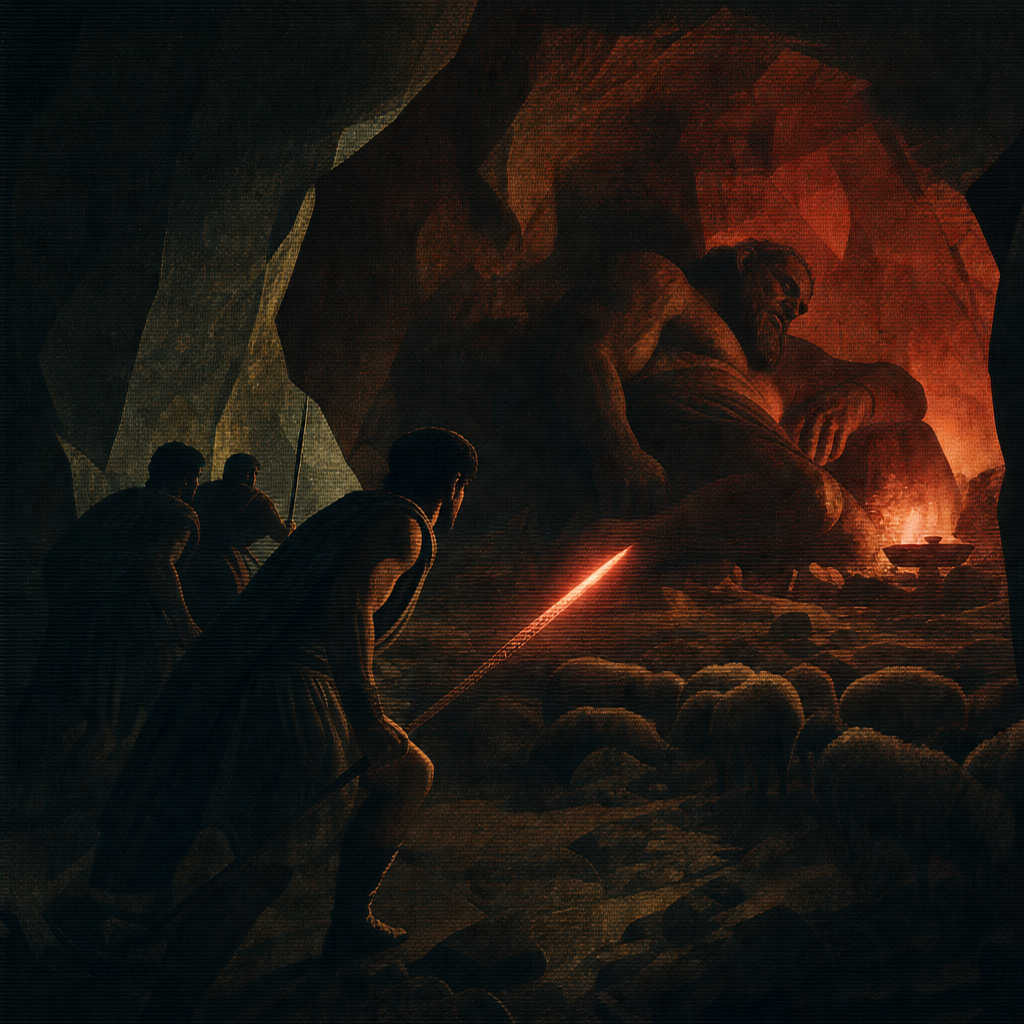
“When we reached the nearby shore, we saw a tall cave close to the sea at the land’s edge, overhung with laurels. Many flocks of sheep and goats would spend the night there. Around it stood a high enclosure built of deeply set boulders, tall pines and lofty-crowned oaks. A monstrous man lived there, pasturing his flocks alone, far from everyone. He never visited the others, but kept apart, knowing no law. He was a monstrous wonder, unlike a bread-eating man, more like a wooded peak of the high mountains, standing apart from the rest.
Read Ancient Greek Source (Odyssey.9.181–Odyssey.9.192)
“Then I ordered the rest of my loyal companions to stay right there by the ship and guard the vessel, while I chose the twelve best men among my crew and set out. I carried with me a goatskin of dark wine, sweet to drink, which Maron, son of Euanthes, had given me—the priest of Apollo, who watches over Ismarus—because we had protected him along with his child and his wife out of reverence; for he lived in the wooded grove of Phoebus Apollo. And he gave me splendid gifts: he gave me seven talents of well-worked gold, and he gave me a mixing bowl of solid silver; and then he drew wine into twelve two-handled jars in all, sweet and unmixed, a divine drink. Not one of the slaves or serving women in his house knew of it, only he himself, his dear wife, and a single housekeeper. Whenever they drank that honey-sweet red wine, he would pour one full cup into twenty measures of water. A sweet, divine fragrance rose from the mixing bowl; you would not have wanted to hold back.
Read Ancient Greek Source (Odyssey.9.193–Odyssey.9.211)
“I filled a great wineskin with this wine and carried it, along with provisions in a leather sack; for my proud heart foreboded at once that a man would come upon us clothed in tremendous strength, a savage who knew neither justice nor custom. Quickly we reached the cave, and we did not find him inside; he was out grazing his fat flocks in the pasture. We went into the cave and gazed at everything. Wicker racks were weighed down with cheeses, and the pens were crowded with lambs and kids. Each group was penned separately: the firstborn by themselves, the middle-born by themselves, and the newborn young by themselves. All the vessels brimmed with whey—the well-made pails and bowls into which he milked.
Read Ancient Greek Source (Odyssey.9.212–Odyssey.9.223)
“My companions first begged me to take cheeses and leave, then drive the kids and lambs from their pens quickly to the swift ship and sail over the salt water. But I would not listen, though that would have been far better. I wanted to see the owner and find out if he would give me gifts as a guest. His appearance was to bring my companions no delight. We lit a fire, offered sacrifice and helped ourselves to cheese. We sat waiting inside until he came back with his flocks. He carried a huge load of dry wood for his supper and threw it down inside with a crash. In fear we hurried to the back of the cave.
Read Ancient Greek Source (Odyssey.9.224–Odyssey.9.236)
“He drove all his fat milking ewes and goats into the broad cave, leaving the males, rams and he-goats, outside the deep enclosure. Then he lifted a huge, heavy stone into the doorway. Twenty-two good four-wheeled wagons could not have shifted it from the ground: that was the sheer mass of rock he set at the entrance. He sat and milked the ewes and bleating goats in due order, putting a young one beneath each mother. He curdled half the white milk and gathered it into woven baskets. He left the other half in vessels, to have at hand to drink with supper.
Read Ancient Greek Source (Odyssey.9.237–Odyssey.9.249)
“When he had hurried through his work, he lit the fire, saw us and asked: ‘Strangers, who are you? Where do you sail from over the watery ways? Are you on business, or do you roam at random like pirates on the sea, risking your lives to bring harm to foreigners?’ Our hearts broke with fear at his deep voice and monstrous bulk. Even so I answered:
Read Ancient Greek Source (Odyssey.9.250–Odyssey.9.258)
“‘We are Achaeans, driven astray from Troy by all kinds of winds over the great sea. We meant to go home, but have come by another way, on different paths. So Zeus must have planned it. We claim to be men of Agamemnon, son of Atreus, whose fame is now greatest under heaven. He sacked so great a city and destroyed so many people. We have come to your knees, hoping you will offer us hospitality or give us a gift, as is the custom toward strangers. Respect the gods, mighty sir. We are your suppliants, and Zeus, protector of strangers, avenges suppliants and guests and attends those who deserve respect.’
Read Ancient Greek Source (Odyssey.9.259–Odyssey.9.271)
“He answered at once with a pitiless heart: ‘You are a fool, stranger, or have come from far away, to tell me to fear or avoid the gods. We Cyclopes care nothing for Zeus who bears the aegis, or the blessed gods. We are much stronger. I would not spare you or your companions to avoid Zeus’s anger unless my own heart urged me. Tell me where you moored your well-built ship when you came. Is she somewhere at the edge of the land or nearby? I want to know.’ He was testing me, but I knew too much to miss it. I answered him with deceitful words: ‘Poseidon the Earth-Shaker broke my ship against the rocks at the edge of your land, driving her against a headland. The wind brought her from the sea. I escaped sheer destruction with these men.’
Read Ancient Greek Source (Odyssey.9.272–Odyssey.9.286)
“He answered nothing in his pitiless heart. He sprang up, stretched out his hands and seized two companions together, dashing them against the ground like puppies. Their brains ran out and soaked the earth. He cut them limb from limb and made his supper, eating like a mountain-bred lion, leaving nothing: guts, flesh and marrow-filled bones. We wept and raised our hands to Zeus at the dreadful sight, helpless at heart. When the Cyclops had filled his great belly with human flesh and washed it down with unmixed milk, he stretched out among the flocks inside the cave. I considered going close, drawing my sharp sword from my thigh and, feeling with my hand for the place where the midriff holds the liver, stabbing him in the chest. But another thought restrained me. We too would die there: our hands could not push away the massive stone he had set at the high doorway. So we groaned and waited for divine Dawn.
Read Ancient Greek Source (Odyssey.9.287–Odyssey.9.306)
“When early-born, rosy-fingered Dawn appeared, he lit the fire and milked his fine flocks in due order, putting a young one beneath each mother. When he had hurried through his work, he seized another two men and made his meal. After eating, he drove the fat flocks out, easily lifting away the great doorstone and setting it back as if he were putting the lid on a quiver. Whistling loudly, the Cyclops drove his flocks toward the mountain. I stayed behind, brooding on mischief, hoping to take revenge and win glory with Athena’s help. This seemed the best plan:
Read Ancient Greek Source (Odyssey.9.307–Odyssey.9.318)
“Beside the pen lay the Cyclops’ great club, of green olive wood, cut to carry once it had dried. To us it looked as long and thick as the mast of a broad, black, twenty-oared cargo ship that crosses the great sea. I stood beside it, cut off a fathom’s length and gave it to my companions to smooth. They made it straight, and I sharpened its end and hardened it in the blazing fire. Then I hid it carefully beneath the great heaps of dung scattered through the cave. I told the others to cast lots for who would dare join me in lifting the stake and turning it in his eye when sweet sleep took him. The lot fell on the four I would have chosen myself, and I was counted as the fifth.
Read Ancient Greek Source (Odyssey.9.319–Odyssey.9.335)
“At evening he returned with his fine-fleeced flocks. He drove all the fat animals into the wide cave, leaving none outside the deep enclosure, either from some suspicion or at a god’s prompting. He lifted the great doorstone into place, sat and milked the ewes and bleating goats in due order, putting a young one beneath each mother. When he had hurried through his work, he again seized two men and made his supper. Then I stood close to the Cyclops and spoke, holding an ivy-wood bowl of dark wine:
Read Ancient Greek Source (Odyssey.9.336–Odyssey.9.346)
“‘Cyclops, here, drink wine after your meal of human flesh, so you can learn what sort of drink our ship held. I brought it as a libation for you, hoping you would pity me and send me home. But your madness is past bearing. Cruel creature, how could anyone else ever come to you again? You have done what is wrong.’ He took it and drank it down, greatly delighting in the sweet drink. He asked for more: ‘Give me more, willingly, and tell me your name at once, so I can give you a guest-gift you will enjoy. The grain-giving earth bears wine from rich grapes for the Cyclopes too, and Zeus’s rain nourishes it. But this is a stream of ambrosia and nectar!’
Read Ancient Greek Source (Odyssey.9.347–Odyssey.9.359)
“I gave him the gleaming wine again. Three times I brought it, and three times he drained it in his folly. When the wine had gone to the Cyclops’ head, I spoke gently: ‘Cyclops, you ask my famous name. I will tell you, but give me the guest-gift you promised. My name is Nobody. My mother, father and all my companions call me Nobody.’ He answered with a pitiless heart: ‘I will eat Nobody last, after his companions. I will eat the others first. That will be your guest-gift.’ He fell back, his thick neck lolling to one side, and sleep that conquers all took him. Wine and scraps of human flesh poured from his throat as he belched in his drunkenness.
Read Ancient Greek Source (Odyssey.9.360–Odyssey.9.374)
“I thrust the stake deep into the ashes to heat and encouraged all my companions, lest anyone shrink back in fear. When the green olive stake was about to catch fire and glowed terribly, I brought it close from the fire. My companions stood around it, and a god breathed great courage into us. They took the pointed olive stake and drove it into his eye. Leaning down from above I turned it, as a man drills a ship’s timber while others below pull a strap back and forth from either end, keeping the drill spinning steadily. So we held the fire-sharpened stake and turned it in his eye. Blood flowed around the hot wood. Steam from the burning eyeball singed his eyelids and brows, and its roots crackled in the fire. As a smith dips a great axe or adze into cold water and it hisses loudly, tempering it—for that gives iron its strength—so his eye hissed around the olive stake.
Read Ancient Greek Source (Odyssey.9.375–Odyssey.9.394)
“He gave a terrible roar that echoed round the rock. We scattered in fear. He pulled the stake out of his eye, streaming with blood, and flung it from him with frantic hands. Then he shouted to the Cyclopes who lived around him in caves along the windy heights. They heard and came from every side, stood around his cave and asked what troubled him: ‘Polyphemus, why cry out in such distress through the immortal night and keep us awake? Is some mortal driving your flocks away against your will? Is someone killing you by cunning or force?’ Strong Polyphemus called from the cave: ‘Friends, Nobody is killing me by cunning, not by force!’ They answered with winged words: ‘If no one is attacking you and you are alone, there is no escaping a sickness sent by great Zeus. Pray to your father, lord Poseidon.’ They went away, and my heart laughed at how my name and excellent cunning had deceived them.
Read Ancient Greek Source (Odyssey.9.395–Odyssey.9.414)
“Groaning in pain, the Cyclops groped with his hands and removed the stone from the doorway. He sat in the entrance with arms outspread, hoping to catch anyone going outside among the sheep. He thought me that much of a fool! I considered how best to find an escape from death for my companions and myself, weaving every trick and plan as a man does for his life: great danger was close. This seemed the best plan. The rams were well fed, thick-fleeced, fine and large, with violet-dark wool. Quietly I bound them in threes with the well-twisted withies on which the monstrous, lawless Cyclops slept. The middle ram carried a man, while the other two on either side shielded my companions. Three sheep carried each man. As for me, there was one ram by far the best of the flock. I caught him by the back and curled beneath his shaggy belly, twisting my hands in his marvelous fleece and clinging there with an enduring heart. So we groaned and waited for divine Dawn.
Read Ancient Greek Source (Odyssey.9.415–Odyssey.9.436)
“When early-born, rosy-fingered Dawn appeared, the male sheep rushed out to pasture. The females bleated around the pens, unmilked, their udders bursting. Tormented by pain, their master felt the backs of all the sheep as they stood upright. The fool never noticed my men bound beneath the breasts of the woolly animals. The ram went out last, burdened by his fleece and by me with all my plans. Strong Polyphemus felt him and said:
Read Ancient Greek Source (Odyssey.9.437–Odyssey.9.446)
“‘Dear ram, why are you coming through the cave last of the flock? You never used to lag behind the sheep. You were always first to feed, striding out to the tender flowers of grass, first at the river streams, first eager to come back to the fold at evening. Now you are last of all. Do you miss your master’s eye? A wicked man put it out with his vile companions, overcoming my wits with wine—Nobody, who I say has not escaped destruction yet. If only you could think as I do and speak, to tell me where he is hiding from my fury! I would dash him against the ground till his brains scattered all over the cave. That would ease my heart of the misery worthless Nobody has brought me.’
Read Ancient Greek Source (Odyssey.9.447–Odyssey.9.460)
“With that he sent the ram outside. When we were a little way from the cave and enclosure, I first freed myself from beneath the ram, then released my companions. Quickly we gathered and drove many long-legged sheep, fat and heavy, until we reached the ship. Our dear companions welcomed us who had escaped death, while mourning those who were gone. I would not let them weep. With a lift of my brows I signaled each man to stop, and ordered them to put the fine-fleeced flock quickly aboard and sail over the salt water. They boarded at once, sat in rows and struck the gray sea with their oars. When we were a shout’s distance away, I called to the Cyclops in mockery: ‘Cyclops, the man whose companions you ate by brute force in your hollow cave was no weakling! Your evil deeds were bound to catch you. Cruel creature, you did not shrink from eating guests in your own house. Now Zeus and the other gods have paid you back.’
Read Ancient Greek Source (Odyssey.9.461–Odyssey.9.479)
“So I spoke, and then he grew even more furious at heart. He tore away the peak of a great mountain and hurled it, flinging it down in front of our dark-prowed ship just a short way out, and it barely missed the tip of the steering oar. The sea surged up beneath the plunging rock, and at once a surging backwash carried our ship toward the shore, a flood-swell from the open sea that forced her onto dry land. But I seized a long pole in both hands and shoved her clear; then, rousing my companions, I ordered them to throw their weight on the oars so we could escape from disaster, motioning with a nod of my head; and they leaned forward and rowed.
Read Ancient Greek Source (Odyssey.9.480–Odyssey.9.490)
“When we had cut through the salt sea and were twice as far out, I started to call out to the Cyclops, while all around me my companions tried to hold me back with coaxing words from every side: ‘Reckless man, why do you want to provoke a savage man? Just now, by hurling his missile into the sea, he drove our ship back to the shore, and we truly thought we would perish right there. If he had heard any one of us make a sound or speak a word, he would have smashed our heads and our ship's timbers together with a cast of a jagged boulder—for he throws that far!’ So they spoke, but they did not persuade my proud spirit, and I called back to him again with anger in my heart: ‘Cyclops, if any mortal asks about the shameful blinding of your eye, tell him that Odysseus, sacker of cities, son of Laertes, whose home is in Ithaca, blinded you!’
Read Ancient Greek Source (Odyssey.9.491–Odyssey.9.505)
“So I spoke, and with a groan he answered me in words: ‘Ah! Truly the prophecies spoken long ago have come upon me. There used to be a prophet here, a noble and tall man, Telemus, son of Eurymus, who excelled in prophecy and grew old prophesying among the Cyclopes. He told me that all these things would be fulfilled in time to come—that at the hands of Odysseus I would be robbed of my sight. Yet I always expected some tall and handsome man to come here, clothed in great strength. But now a small, worthless weakling has put out my eye after overcoming me with wine. Come here, Odysseus, so I can offer you guest-gifts and urge the glorious Earth-Shaker to give you passage home. I am his son, and he declares himself my father. If he wishes, he will heal me himself. No one else can, neither blessed god nor mortal man.’
Read Ancient Greek Source (Odyssey.9.506–Odyssey.9.521)
“I answered him: ‘If only I could strip you of life and breath and send you to the house of Hades as surely as not even the Earth-Shaker will heal your eye!’ Then he prayed to lord Poseidon, stretching his hands toward starry heaven: ‘Hear me, Poseidon, holder of the earth, dark-haired god. If I truly am your son and you declare yourself my father, grant that Odysseus, sacker of cities, son of Laertes, whose home is in Ithaca, never returns home. But if it is his fate to see his loved ones and reach his well-built house and native land, let him come late, in misery, having lost all his companions, in another man’s ship, and find trouble at home.’ So he prayed, and the dark-haired god heard him.
Read Ancient Greek Source (Odyssey.9.522–Odyssey.9.536)
“He lifted a much larger rock, swung it round and threw with immeasurable force. It landed just behind the dark-prowed ship, barely missing the steering oar’s tip. The sea surged up beneath the falling rock, and the wave carried the ship forward, forcing her toward the shore. When we reached the island where our other well-benched ships waited together, our companions sat around them grieving, always watching for us. We beached our ship on the sand and stepped out beside the breaking surf.
Read Ancient Greek Source (Odyssey.9.537–Odyssey.9.547)
“We took the Cyclops’ sheep out of the hollow ship and divided them so no one would be cheated of an equal share. My companions in fine leg armor gave me the ram as a special share. On the shore I sacrificed him to Zeus of the dark clouds, Cronus’ son who rules over all, and burned the thigh-pieces. But Zeus took no heed of the offering. He was planning how all my well-benched ships and loyal companions should perish. All day until sunset we sat feasting on abundant meat and sweet wine. When the sun went down and darkness came on, we slept beside the breaking surf.
Read Ancient Greek Source (Odyssey.9.548–Odyssey.9.559)
“When early-born, rosy-fingered Dawn appeared, I urged my companions to board and loose the stern lines. They boarded at once, sat in rows and struck the gray sea with their oars. We sailed on with aching hearts, glad to be alive but bereft of our dear companions.”