Book 24: Priam Ransoms Hector’s Body
Ἰλιάς · Book 24 · Classix Modern English Reading Edition
The assembly broke up, and the men scattered, each going to his own swift ship. The others turned their thoughts to supper and to taking their fill of sweet sleep; yet Achilles wept, remembering his dear companion, and sleep, which tames all things, could not take him. He tossed from side to side, longing for Patroclus's manhood and his noble strength, and for all that he had seen through with him and the hard pains he had suffered, cleaving his way through the wars of men and the grievous waves. Remembering these things, he shed warm, heavy tears, lying now on his side, now again on his back, and now face down; then, springing to his feet, he would wander distraught along the shore of the sea. Never did Dawn appear over the sea and the beaches without his seeing her.
Read Ancient Greek Source (Iliad.24.1–Iliad.24.13)
Then, when he had yoked his swift horses under the chariot, he would bind Hector behind the car to drag him; and when he had hauled him three times around the burial mound of Menoetius's dead son, he would rest again in his shelter, leaving Hector stretched face down in the dust. Yet Apollo kept all disfigurement from his skin, pitying the warrior even in death, and wrapped him entirely in the golden aegis so that Achilles would not tear his flesh as he dragged him.
Read Ancient Greek Source (Iliad.24.14–Iliad.24.21)
So in his rage he defiled noble Hector; but the blessed gods pitied him as they looked on, and kept urging the keen-eyed Slayer of Argus to steal the body away. Now this pleased all the other gods, but never Hera, nor Poseidon, nor the bright-eyed daughter of Zeus; they clung to the hatred they had felt from the first for sacred Ilium, and Priam and his people, because of the blindness of Alexander, who insulted the goddesses when they came to his shepherd's courtyard and praised her who gave him ruinous lust.
Read Ancient Greek Source (Iliad.24.22–Iliad.24.30)
But when the twelfth dawn from that day had come, Phoebus Apollo spoke out among the immortals: "You are ruthless, you gods, and cruel. Did Hector never burn for you thigh-bones of unblemished bulls and goats? Yet now you cannot bring yourselves to save him, even as a corpse, for his wife to look upon, and his mother and his child, and his father Priam and his people, who would quickly burn him in the fire and give him his funeral rites. Instead, you gods choose to help murderous Achilles, whose mind is without justice and whose purpose cannot be bent within his chest. His thoughts are savage as a lion's that yields to its great strength and proud spirit and goes out against men's flocks to seize its feast. Just so has Achilles lost all pity, and in him there is no respect, which both greatly harms men and greatly helps them.
Read Ancient Greek Source (Iliad.24.31–Iliad.24.45)
"A man may well lose someone even dearer than this—a brother born of the same womb, or even a son—and yet when he has wept and mourned, he lets go, for the Fates have given mortals an enduring heart. But this man, after robbing noble Hector of his life, ties him behind his horses and drags him around the tomb of his dear companion; and there is nothing fine or better for him in that. Brave though he is, let him take care that we do not grow indignant with him, for in his fury he is defiling senseless earth."
Read Ancient Greek Source (Iliad.24.46–Iliad.24.54)
Angered, white-armed Hera answered him: "What you say might hold true, lord of the silver bow, if you gods mean to give equal honor to Achilles and to Hector. Hector is mortal and nursed at a woman's breast, while Achilles is the child of a goddess whom I myself reared and cherished and gave as wife to a man, to Peleus, who was dear to the hearts of the immortals. All of you gods came to the wedding; and among them you feasted with lyre in hand, comrade of the base, faithless as ever."
Read Ancient Greek Source (Iliad.24.55–Iliad.24.63)
Cloud-gathering Zeus answered her: "Hera, do not rage so utterly against the gods. Their honor shall not be the same; yet Hector too was dearest to the gods of all the mortals in Ilium—at least to me, for he never failed in the gifts I loved. Never did my altar lack its due share of the feast, or libation and the savor of burnt fat, the privilege allotted to us. Still, we will let go any thought of stealing brave Hector away—nor could it be done behind Achilles's back, for his mother is always at his side, night and day alike. But if one of the gods would call Thetis here to me, I will speak a wise word to her, so that Achilles may accept gifts from Priam and release Hector."
Read Ancient Greek Source (Iliad.24.64–Iliad.24.76)
So he spoke, and storm-footed Iris rose to bear the message. Midway between Samos and craggy Imbros she plunged into the dark sea, and the waters groaned around her. She plummeted into the depths like a lead weight that, fitted to the horn of a field-dwelling ox, sinks down bringing death to ravenous fish. In a hollow cave she found Thetis, and around her the other sea-goddesses sat gathered; and there in their midst she was weeping for the fate of her noble son, who was destined to perish in fertile Troy, far from his fatherland.
Read Ancient Greek Source (Iliad.24.77–Iliad.24.86)
Swift-footed Iris stood near and spoke to her: "Rise, Thetis; Zeus, whose counsels never perish, summons you." Then the silver-footed goddess Thetis answered her: "Why does that great god summon me? I shrink from mingling with the immortals, for I have measureless grief in my heart. Yet I will go, and no word he speaks shall be in vain."
Read Ancient Greek Source (Iliad.24.87–Iliad.24.92)
So speaking, the shining goddess took up her dark veil—no garment was ever blacker than that. She set out on her way, and ahead of her wind-footed, swift Iris led the path, while around them the waves of the sea parted. Stepping out upon the shore, they darted up to heaven, and found the far-seeing son of Cronus, while around him all the others sat gathered, the blessed gods who live forever. She sat down beside Father Zeus, and Athena yielded her place. Hera set a beautiful golden cup in her hand and comforted her with words; and Thetis drank and handed back the cup.
Read Ancient Greek Source (Iliad.24.93–Iliad.24.102)
Then the father of men and gods began to speak among them: "You have come to Olympus, goddess Thetis, despite your sorrow, bearing unforgettable grief in your heart; I know it myself. Even so, I will tell you why I called you here. For nine days now a quarrel has risen among the immortals over Hector's corpse and Achilles, sacker of cities. They keep urging the keen-eyed Slayer of Argus to steal the body, yet I grant this glory to Achilles, guarding for the future my respect and love for you. Go quickly to the camp and give your son this command: tell him that the gods are angry with him, and that I above all the immortals am filled with wrath, because in his raging heart he holds Hector beside the curved ships and has not given him back. Perhaps then he will fear me and release Hector. Meanwhile I will send Iris to great-hearted Priam, bidding him go to the ships of the Achaeans to ransom his dear son and bring gifts to Achilles that will warm his heart."
Read Ancient Greek Source (Iliad.24.103–Iliad.24.119)
So he spoke, and the silver-footed goddess Thetis did not disobey, but darted down from the peaks of Olympus. She came to her son's shelter, and there she found him groaning heavily, while around him his dear companions were busily working and making ready their morning meal, for a great thick-fleeced sheep had been slaughtered for them in the shelter. His revered mother sat down right beside him, stroked him with her hand, and spoke to him, calling him by name:
Read Ancient Greek Source (Iliad.24.120–Iliad.24.127)
"My child, how long will you weep and grieve, devouring your own heart, with no thought for food or for bed? It is a good thing even to lie with a woman in love—for you will not live long for me, but already death and overpowering fate stand close beside you. Listen to me quickly, for I am a messenger to you from Zeus. He says that the gods are angry with you, and that he above all the immortals is filled with wrath, because in your raging heart you hold Hector beside the curved ships and have not given him back. Come then, release him, and accept ransom for the dead man."
Read Ancient Greek Source (Iliad.24.128–Iliad.24.137)
Then swift-footed Achilles answered her: "So be it. Let the man who brings the ransom take away the dead, if indeed the Olympian himself commands it with earnest heart." So there among the gathered ships mother and son spoke many winged words to one another.
Read Ancient Greek Source (Iliad.24.138–Iliad.24.142)
Meanwhile the son of Cronus sent Iris on to sacred Ilium: "Go now, swift Iris, leave the seat of Olympus, and bring word to great-hearted Priam within Ilium to go alone to the ships of the Achaeans to ransom his dear son, bringing gifts to Achilles that will warm his heart; let no other man of the Trojans go with him. Only let an older herald attend him, one who can guide the mules and the smooth-wheeled wagon, and then carry back to the city the dead man whom noble Achilles killed. Let neither death nor any terror trouble his mind, for we will send him such a guide, the Slayer of Argus, who will lead him all the way until he brings him to Achilles. And once he has led him inside Achilles's shelter, Achilles himself will not kill him, and he will hold back all the others; for he is neither mindless nor heedless nor an offender against the gods, but with all care he will spare a suppliant man."
Read Ancient Greek Source (Iliad.24.143–Iliad.24.158)
So he spoke, and storm-footed Iris rose to carry the message. She came to Priam's house and found crying and lamentation. His sons sat around their father inside the courtyard, drenching their clothes with tears, while in their midst the old man sat huddled, wrapped tightly in his cloak, so that the outline of his body showed through; and thick dung lay upon the old man's head and neck, which he had scooped up with his own hands as he rolled on the ground. Throughout the halls his daughters and his sons' wives were wailing, remembering all those men, many and brave, who lay dead, having lost their lives at the hands of the Argives.
Read Ancient Greek Source (Iliad.24.159–Iliad.24.168)
The messenger of Zeus stood beside Priam and spoke to him in a low voice, and trembling seized his limbs: "Take heart in your breast, Priam, descendant of Dardanus, and do not be afraid. I have not come here foreboding evil for you, but with good intent; for I am a messenger to you from Zeus, who, far away though he is, cares greatly for you and pities you. The Olympian commands you to go alone to ransom noble Hector, bringing gifts to Achilles that will warm his heart; let no other man of the Trojans go with you. Only let an older herald attend you, one who can guide the mules and the smooth-wheeled wagon, and then carry back to the city the dead man whom noble Achilles killed. Let neither death nor any terror trouble your mind, for such a guide will go with you, the Slayer of Argus, who will lead you all the way until he brings you to Achilles. And once he has led you inside Achilles's shelter, Achilles himself will not kill you, and he will hold back all the others; for he is neither mindless nor heedless nor an offender against the gods, but with all care he will spare a suppliant man."
Read Ancient Greek Source (Iliad.24.169–Iliad.24.187)
Having spoken thus, swift-footed Iris departed. Then Priam ordered his sons to make ready the smooth-wheeled mule wagon and lash the wicker box upon it. He himself went down into the fragrant storeroom, high-roofed and lined with cedar, which held many treasures, and he called in Hecuba his wife and said to her: "Strange woman, an Olympian messenger has come to me from Zeus, telling me to go to the ships of the Achaeans to ransom our dear son, and bring gifts to Achilles that will warm his heart. Come then, tell me this: how does it seem to your mind? For my own spirit and heart fiercely urge me to go there to the ships, into the wide camp of the Achaeans."
Read Ancient Greek Source (Iliad.24.188–Iliad.24.199)
So he spoke, and his wife cried out aloud and answered him: "Ah me, where have your senses gone, for which you used to be famous among foreign peoples and among those you rule? How can you wish to go alone to the ships of the Achaeans, before the eyes of a man who has slain and stripped so many of your brave sons? Your heart is surely made of iron. For if he catches you and sets his eyes upon you, that eater of raw flesh, that faithless man, he will show you no pity and no respect at all. No, let us weep for Hector from afar, sitting here in our hall; for so overpowering Fate spun it with her thread for him at his birth, when I myself bore him, that he should glut the swift-footed dogs, far from his parents, in the power of that violent man—into the middle of whose liver I wish I could sink my teeth and feed! Then there would be payback for my son, since when Achilles killed him, Hector was no coward: he stood his ground before the Trojans and the deep-robed Trojan women, with no thought of flight or shelter."
Read Ancient Greek Source (Iliad.24.200–Iliad.24.216)
Then the old man, godlike Priam, answered her: "Do not hold me back when I am resolved to go, and do not yourself be a bird of ill omen in my halls; you will not persuade me. If anyone else who walks the earth had told me to go—one of the seers who read the burnt offerings, or the priests—we would call it a lie and turn our backs on it all the more. But now, since I myself heard the goddess and looked her in the face, I will go, and the word will not be in vain. And if it is my fate to die beside the ships of the bronze-armored Achaeans, I am willing: let Achilles kill me on the spot, once I have taken my son in my arms and put away my longing for tears."
Read Ancient Greek Source (Iliad.24.217–Iliad.24.227)
He spoke, and threw open the handsome lids of his chests. From them he took out twelve exquisite robes, twelve single-fold cloaks, and as many rugs, as many white mantles, and besides those as many tunics. He weighed out and brought ten full talents of gold, and brought out two gleaming tripods, four cauldrons, and a magnificent cup that the men of Thrace had given him when he went there on an embassy, a great treasure; not even that did the old man spare in his halls, so fiercely did his heart long to ransom his dear son. Then he drove all the Trojans back from the portico, berating them with shameful words: "Get out, you shameful nuisances! Have you no mourning of your own at home, that you come here to torment me? Or do you think it a small thing that Zeus son of Cronus gave me this grief, to lose the bravest of my sons? You will feel it yourselves soon enough: you will be far easier for the Achaeans to slaughter now that he is dead. But as for me, before my eyes see our city plundered and laid waste, may I go down into the house of Hades."
Read Ancient Greek Source (Iliad.24.228–Iliad.24.246)
He spoke, and drove the men off with his staff; and they hurried outside before the old man's fury. Then he shouted at his own sons, upbraiding Helenus, Paris, and noble Agathon, Pammon, Antiphonus, and Polites, strong at the war cry, Deiphobus, Hippothous, and noble Agauus—to all nine of them the old man shouted his commands: "Hurry for me, you worthless children, my disgrace! Would that all of you together had been killed beside the swift ships instead of Hector! How utterly cursed I am! I fathered the bravest sons in all wide Troy, and now I say not one of them is left—godlike Mestor, and Troilus who fought from his chariot, and Hector, who was a god among men, and never seemed to be the son of a mortal man, but of a god. Ares has killed them all, and all these disgraces are left behind—liars and dancers, champions at beating the dance floor, plunderers of your own people's lambs and kids! Will you not get my wagon ready at once, and load all these things onto it, so we can be on our way?"
Read Ancient Greek Source (Iliad.24.247–Iliad.24.264)
So he spoke, and shrinking before their father's rebuke they hauled out the smooth-wheeled mule wagon, handsome and newly built, and lashed the wicker box onto it. Down from its peg they took the mule yoke of boxwood, with its central boss, well fitted with guide-rings, and with the yoke they brought out the nine-cubit yoke-strap. They set the yoke carefully on the polished pole at its far tip, slipped the ring over the pin, lashed the strap three times each way around the boss, and then bound it straight along the pole and tucked the end under the hook. Carrying the treasure from the storeroom to the polished wagon, they piled up the boundless ransom for Hector's head, and yoked the strong-hooved mules trained to work in harness, a splendid gift that the Mysians had once given to Priam. Then for Priam they led under the yoke the horses that the old man kept for himself and tended at the polished manger.
Read Ancient Greek Source (Iliad.24.265–Iliad.24.280)
There in the high palace the two of them were having their teams yoked—the herald and Priam, holding deep counsels in their hearts—when Hecuba came up to them with an aching heart, carrying honey-sweet wine in her right hand in a golden cup, so that the two might pour a libation before setting out. She stood in front of the horses and spoke to him, calling him by name: "Here, pour a libation to Father Zeus, and pray that you come home safe from your enemies, since your own spirit drives you on to the ships against my will. Pray then to the dark-clouded son of Cronus, lord of Ida, who looks down over all of Troy, and ask him for a bird of omen, his swift messenger, the one that is dearest of all birds to him and greatest in strength, on your right hand, so that once you have seen it with your own eyes you may trust in that sign as you go to the ships of the swift-horsed Danaans. But if wide-seeing Zeus refuses to send you his own messenger, then I would never urge you on or tell you to go to the ships of the Argives, no matter how eager you are."
Read Ancient Greek Source (Iliad.24.281–Iliad.24.298)
Godlike Priam answered her: "Wife, in this I will not disobey your urging; it is a good thing to lift one's hands to Zeus, in hope that he may have pity." So the old man spoke, and told the serving-woman who kept the house to pour pure water over his hands; and the serving-woman came and stood by him, holding both the basin and the pitcher in her hands. When he had washed, he took the cup from his wife. Then he stood in the middle of the courtyard and prayed, pouring out the wine as he looked up to heaven, and raised his voice to speak:
Read Ancient Greek Source (Iliad.24.299–Iliad.24.307)
"Father Zeus, ruling from Ida, most glorious and greatest, grant that I come to Achilles's shelter welcomed as a friend and pitied, and send a bird of omen, your swift messenger, the one that is dearest of all birds to you and greatest in strength, on my right hand, so that once I have seen it with my own eyes I may trust in that sign as I go to the ships of the swift-horsed Danaans."
Read Ancient Greek Source (Iliad.24.308–Iliad.24.313)
So he spoke in prayer, and Zeus the counselor heard him. At once he sent an eagle, the surest omen of all winged birds, the dark hunter that men also call the black eagle. As wide as the doorway made for the high-roofed chamber of a wealthy man, well fitted with its bolts, so wide was the span of its wings on either side. It appeared to them sweeping on the right across the city; and when they saw it they rejoiced, and the hearts in all their breasts grew warm.
Read Ancient Greek Source (Iliad.24.314–Iliad.24.321)
In haste the old man stepped up into his chariot and drove out through the gateway and the echoing portico. In front, the mules pulled the four-wheeled wagon, driven by wise Idaeus; and behind came the horses, which the old man urged on with his whip swiftly through the city, while all his loved ones followed after him, weeping bitterly as though he were going to his death.
Read Ancient Greek Source (Iliad.24.322–Iliad.24.328)
When they had gone down from the city and reached the plain, his sons and his sons-in-law turned back again to Ilium; but the two men did not escape the notice of wide-seeing Zeus as they came out onto the plain. Seeing the old man, he pitied him, and at once he spoke face to face to Hermes, his dear son: "Hermes, since you above all love best to be a companion to a mortal man, and you listen to whomever you wish, go now, and lead Priam to the hollow ships of the Achaeans in such a way that no one among the rest of the Danaans sees him or even notices him before he reaches the son of Peleus."
Read Ancient Greek Source (Iliad.24.329–Iliad.24.338)
So he spoke, and the guide, Slayer of Argus, did not disobey. At once he bound beneath his feet his lovely sandals, immortal and golden, which carried him both over the wet sea and over the boundless earth with the blasts of the wind. He took up the wand with which he charms the eyes of whatever men he wishes, while others again he wakes from sleep. Holding this in his hands, the strong Slayer of Argus flew on. Quickly he reached Troy and the Hellespont, and went on his way looking like a young prince with his first beard just showing, when youth has its greatest grace.
Read Ancient Greek Source (Iliad.24.339–Iliad.24.348)
Now when the two had driven past the great burial mound of Ilus, they halted the mules and the horses so that they might drink in the river; for darkness had already come down over the earth. Then the herald saw Hermes nearby and took note of him, and he spoke to Priam and said: "Be on your guard, descendant of Dardanus! This is a moment that calls for a wary mind. I see a man, and I think he will soon tear us to pieces. Come, let us flee with the horses, or else let us clasp his knees and beg him, in hope that he may take pity on us."
Read Ancient Greek Source (Iliad.24.349–Iliad.24.357)
So he spoke, and the old man's mind was confounded, and he was terribly afraid; the hair bristled upright on his bent limbs, and he stood dazed. But the helper himself came up close, took the old man's hand, and questioned him and spoke: "Where, father, are you driving your horses and mules like this through the immortal night, when other mortals are asleep? Are you not even afraid of the Achaeans, who breathe fury, your bitter, unforgiving foes, who are close at hand? If one of them should see you through the swift black night carrying so much treasure, what would your thought be then? You are no longer young, and the man who attends you is old too; neither of you can fight off a man who attacks you. Yet I will do you no harm at all; in fact I would defend you against anyone else, for I see in you the likeness of my own dear father."
Read Ancient Greek Source (Iliad.24.358–Iliad.24.371)
Then the old man, godlike Priam, answered him: "Indeed, dear child, all this is somehow just as you say. Yet even now some one of the gods has held his hand over me, sending a traveler such as you to meet me on my way, a fortunate omen—wondrous as you are in build and beauty, and wise in mind; truly you come from blessed parents."
Read Ancient Greek Source (Iliad.24.372–Iliad.24.377)
Then the guide, Slayer of Argus, spoke to him in turn: "Yes, old man, all that you have said is spoken fittingly. But come, tell me this and recount it truly: are you sending this great store of fine treasures away somewhere to foreign peoples, so that it may remain safe for you, or are all of you now abandoning sacred Ilium in terror, since so great a man, the bravest of all, has perished—your own son? For he never fell short of the Achaeans in battle."
Read Ancient Greek Source (Iliad.24.378–Iliad.24.385)
Then the old man, godlike Priam, answered him: "Who are you, noble friend, and from what parents are you born, that you speak so fairly to me of the doom of my ill-fated son?"
Read Ancient Greek Source (Iliad.24.386–Iliad.24.388)
Then the guide, Slayer of Argus, spoke to him in turn: "You are testing me, old man, when you ask about noble Hector. Time and again in battle where men win glory I saw him with my own eyes, and especially when he drove the Argives back to the ships and kept slaughtering them, tearing them with sharp bronze; and we stood watching in wonder, because Achilles would not let us fight, in his anger against the son of Atreus. For I am his attendant, and a single well-built ship brought us both. I am one of the Myrmidons, and my father is Polyctor. He is a wealthy man, and old now, just as you are here; he has six other sons, and I am his seventh. When I cast lots with them, it fell to me to follow the army here. Now I have come out to the plain from the ships, for at dawn the bright-eyed Achaeans will set their battle line around the city. They chafe at sitting idle, and the kings of the Achaeans cannot hold them back in their eagerness for war."
Read Ancient Greek Source (Iliad.24.389–Iliad.24.404)
Then the old man, godlike Priam, answered him: "If indeed you are an attendant of Achilles, son of Peleus, come now, tell me the whole truth: is my son still beside the ships, or by now has Achilles hacked him limb from limb and thrown him to his dogs?"
Read Ancient Greek Source (Iliad.24.405–Iliad.24.409)
Then the guide, Slayer of Argus, spoke to him in turn: "Old man, neither dogs nor birds of prey have eaten him yet, but he still lies there beside the ship of Achilles, just as he was, among the shelters. This is the twelfth dawn that he has lain there, yet his flesh does not rot at all, nor do maggots feed on him, such as devour men slain in war. True, Achilles drags Hector pitilessly around the burial mound of his dear companion whenever bright dawn appears, yet he does not disfigure him. You yourself would marvel if you came to see how fresh as dew he lies, with the blood washed away from him, and nowhere defiled; and all the wounds have closed where he was struck, for many men drove their bronze into him. So deeply do the blessed gods care for your brave son, even though he is a corpse, because he was dear to their hearts."
Read Ancient Greek Source (Iliad.24.410–Iliad.24.423)
So he spoke, and the old man rejoiced and answered him with these words: "My child, truly it is a good thing to give due offerings to the immortals, since my son—as sure as ever he lived—never forgot in our halls the gods who hold Olympus; therefore they have remembered it for him even in the fate of death. But come now, accept from me this fine goblet; protect me yourself, and with the gods' help escort me, until I reach the shelter of the son of Peleus."
Read Ancient Greek Source (Iliad.24.424–Iliad.24.431)
Then the guide, Slayer of Argus, spoke to him in turn: "You are testing me, old man, because I am younger, but you will not persuade me, telling me to accept your gifts behind Achilles's back. I fear him, and in my heart I shrink from robbing him, lest some evil come upon me hereafter. Still, as your escort I would go all the way to famous Argos, attending you faithfully in a swift ship or on foot by your side; and no one would scorn your guide and fight against you."
Read Ancient Greek Source (Iliad.24.432–Iliad.24.439)
So he spoke, and the helper sprang up to the chariot and horses, quickly took the whip and reins in his hands, and breathed bold strength into the horses and the mules. When they reached the ditch and the towers guarding the ships, the sentries were just busying themselves with their evening meal; the guide, Slayer of Argus, poured sleep over them all, and at once opened the gates, shoved back the bars, and brought in Priam and the splendid gifts on the wagon.
Read Ancient Greek Source (Iliad.24.440–Iliad.24.447)
Then they came to the tall shelter of Peleus's son, which the Myrmidons had built for their lord, hewing beams of fir; overhead they had roofed it with shaggy reed-thatch mowed from the meadows, and around it they had made a great courtyard for their lord with close-set stakes. A single bar of fir held the door, one that three Achaeans used to ram home, and three of the rest used to draw back the huge bolt of the doors, though Achilles could ram it shut all alone. Then the helper Hermes opened it for the old man, brought in the glorious gifts for the swift-footed son of Peleus, stepped down from the chariot to the ground, and spoke:
Read Ancient Greek Source (Iliad.24.448–Iliad.24.459)
"Old man, I who have come to you am an immortal god, Hermes; for my father sent me to guide your way. Yet now I will turn back, and will not come before Achilles's eyes; it would provoke indignation for an immortal god to show favor to mortals so openly face to face. Go inside yourself, clasp the knees of Peleus's son, and beg him in the name of his father, his lovely-haired mother, and his child, so that you may stir his heart."
Read Ancient Greek Source (Iliad.24.460–Iliad.24.467)
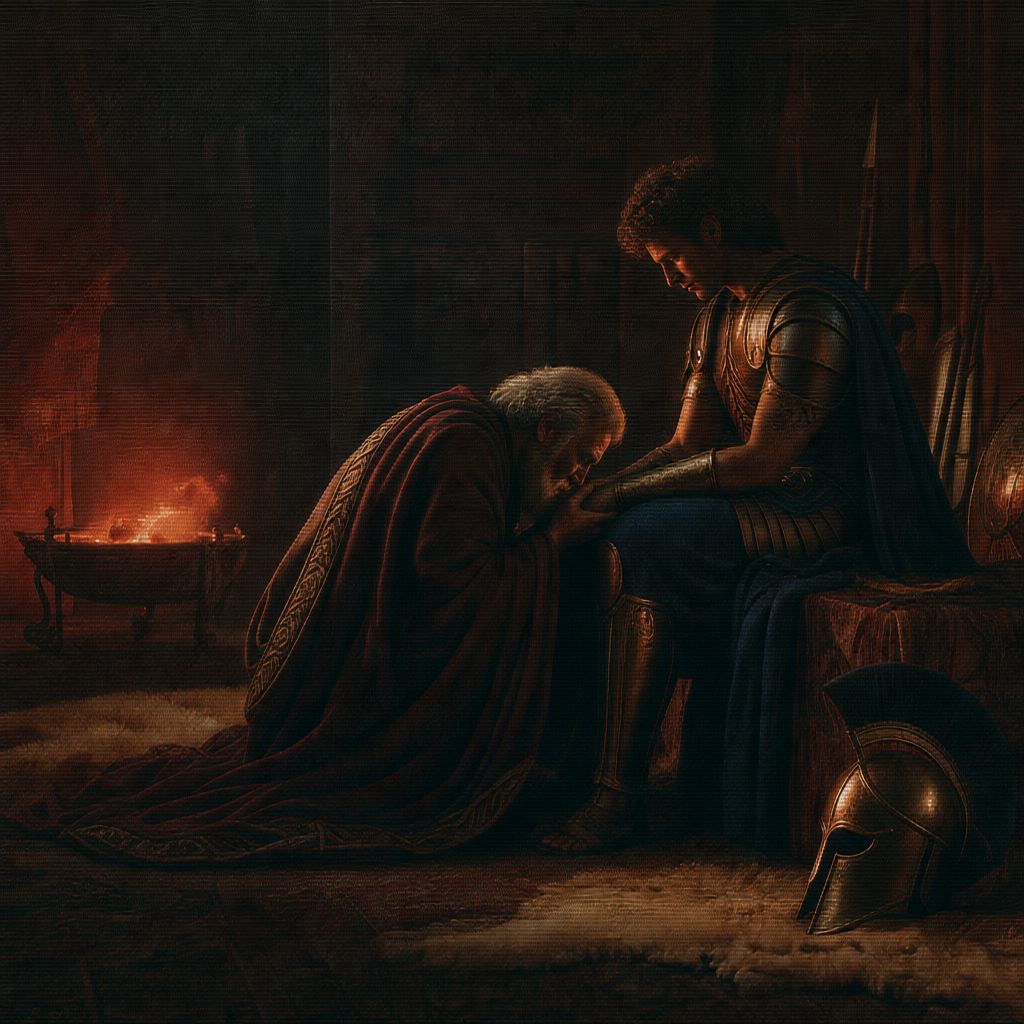
With these words Hermes departed for high Olympus; and Priam leaped down from the chariot to the ground and left Idaeus there behind. The herald stayed holding the horses and the mules, while the old man went straight into the house where Achilles, dear to Zeus, used to sit. Inside he found Achilles himself, while his companions sat apart; only two of them, the hero Automedon and Alcimus, scion of Ares, were busy attending him close by. He had just finished his meal, eating and drinking, and the table still stood beside him. Great Priam came in unseen by them, and standing close beside Achilles took his knees in his hands and kissed his terrible, man-killing hands, which had slain so many of Priam’s sons.
Read Ancient Greek Source (Iliad.24.468–Iliad.24.479)
Just as when heavy ruin seizes a man who has killed someone in his own homeland and comes to the land of others, to the house of a wealthy man, and wonder holds those who look upon him, so Achilles marveled when he saw godlike Priam; and the others marveled too, and looked at one another. Then Priam entreated him and spoke to him:
Read Ancient Greek Source (Iliad.24.480–Iliad.24.485)
"Remember your father, godlike Achilles, a man of my own years, on the grievous threshold of old age. Perhaps the neighbors around him are harassing him too, and there is no one to ward off ruin and destruction. Yet he at least, hearing that you are alive, rejoices in his heart, and hopes day after day to see his dear son come home from Troy. But I am utterly cursed, for I fathered the bravest sons in wide Troy, and now I say not one of them is left. I had fifty when the sons of the Achaeans came: nineteen were born to me from a single womb, and the others the women in my halls bore to me. Of most of them furious Ares has unstrung the knees; and the one who alone was left to me, who guarded the city and its people, you killed the other day as he fought for his fatherland—Hector. For his sake I come now to the ships of the Achaeans to ransom him from you, and I bring boundless ransom. Respect the gods, Achilles, and take pity on me yourself, remembering your own father; yet I am even more to be pitied, and I have endured what no other mortal on earth has ever done, to lift to my lips the hand of the man who killed my sons."
Read Ancient Greek Source (Iliad.24.486–Iliad.24.506)
So he spoke, and in Achilles he stirred a longing to weep for his own father. Taking the old man by the hand, he gently pushed him back. And as the two remembered—Priam weeping heavily for man-killing Hector as he lay curled before Achilles's feet, while Achilles wept now for his own father, and now again for Patroclus—the sound of their groaning rose through the house. But when noble Achilles had taken his fill of weeping, and the longing for tears had passed from his heart and limbs, he rose at once from his chair and raised the old man by the hand, pitying his gray head and his gray beard, and spoke to him winged words:
Read Ancient Greek Source (Iliad.24.507–Iliad.24.517)
"Poor man, truly you have borne many sorrows in your heart. How could you bring yourself to come alone to the ships of the Achaeans, before the eyes of the man who slew and stripped so many of your brave sons? Your heart is surely made of iron. Come then, sit down upon a chair, and despite our grief let us allow our sorrows to lie quiet in our hearts; for no good comes of chilling lamentation. So the gods have spun the thread for wretched mortals, to live in grief, while they themselves are free from care. For two jars stand on the floor of Zeus holding the gifts he gives, one of evils and the other of blessings. The man to whom Zeus who delights in thunder gives a mingled lot meets now with evil and now with good; but the man to whom he gives only from the jar of sorrows he makes an outcast, and ravenous hunger drives him over the bright earth, and he wanders honored neither by gods nor by mortals.
Read Ancient Greek Source (Iliad.24.518–Iliad.24.533)
"So to Peleus the gods gave splendid gifts from his birth, for he surpassed all men in prosperity and wealth, and ruled over the Myrmidons, and though he was mortal they gave him a goddess to be his wife. Yet on him too a god laid evil, in that no line of royal sons was born to him in his halls, but he fathered a single son, doomed to an untimely death; and even now I cannot tend my father as he grows old, since far from my fatherland I sit here in Troy, bringing sorrow to you and your children. And of you too, old man, we hear that in former times you were prosperous: throughout the lands bounded by Lesbos, the seat of Macar, out at sea, by Phrygia inland, and by the boundless Hellespont, among all these peoples, old man, they say you stood out for your wealth and your sons. But ever since the heavenly gods brought this affliction upon you, around your city there are endlessly battles and the killing of men. Endure, and do not grieve without ceasing in your heart; for you will gain nothing by grieving for your brave son. You will not bring him back to life; you will suffer further sorrow instead."
Read Ancient Greek Source (Iliad.24.534–Iliad.24.551)
Then the old man, godlike Priam, answered him: "Do not make me sit on a chair yet, fostered by Zeus, so long as Hector lies uncared for among the shelters, but release him at once so that I may see him with my own eyes; and accept the great ransom that we bring you. May you have joy of these gifts, and come home to your fatherland, since from the first you have spared me to live and look upon the light of the sun."
Read Ancient Greek Source (Iliad.24.552–Iliad.24.558)
Looking at him darkly, swift-footed Achilles spoke to him: "Do not provoke me any further now, old man; I myself intend to release Hector to you, for a messenger came to me from Zeus—my mother who bore me, the daughter of the Old Man of the Sea. And I know well in my heart, Priam, and it does not escape me, that one of the gods led you to the swift ships of the Achaeans. For no mortal would dare to come into our camp, not even a man in the prime of youth; he could not slip past the sentries, nor could he easily push back the bar of our gates. So do not stir up my heart any more amid my sorrows, lest, old man, I not spare even you yourself within my shelter, suppliant though you are, and so sin against the commands of Zeus."
Read Ancient Greek Source (Iliad.24.559–Iliad.24.570)
So he spoke, and the old man was afraid and obeyed his word. Then the son of Peleus sprang out the door of the house like a lion—not alone, for two attendants went with him, the hero Automedon and Alcimus, whom Achilles honored above all his companions except Patroclus, now dead. They unyoked the horses and the mules, led in the old man's clear-voiced herald, and seated him on a stool; and from the polished wagon they took down the boundless ransom for Hector's head. Yet they left behind two mantles and a finely woven tunic, so that Achilles might wrap the body before giving it to Priam to carry home. Then he called out the serving-women and ordered them to wash and anoint the body, lifting it apart so that Priam would not see his son—lest in his grieving heart Priam could not hold back his anger at the sight of his child, and Achilles’s own spirit be provoked, so that Achilles might kill Priam and sin against the commands of Zeus.
Read Ancient Greek Source (Iliad.24.571–Iliad.24.586)
When the serving-women had washed the body and anointed it with olive oil, and had cast a handsome mantle and a tunic around him, Achilles himself lifted him and laid him upon a bier, and his companions together raised him onto the polished wagon. Then he groaned aloud, and called upon his dear companion by name: "Do not be angry with me, Patroclus, if you hear even in the house of Hades that I have released noble Hector to his father, since it was no unworthy ransom that he gave me. And to you in turn I will give your fitting share of these gifts as well."
Read Ancient Greek Source (Iliad.24.587–Iliad.24.595)
So he spoke, and noble Achilles went back into the shelter, sat down against the opposite wall on the richly worked chair from which he had risen, and spoke to Priam: "Your son is released to you now, old man, as you asked, and lies upon a bier; at the break of dawn you yourself will see him as you take him home. But now let us turn our thoughts to supper. For even lovely-haired Niobe remembered to eat, though twelve children perished in her halls—six daughters and six sons in the prime of their youth. Apollo slew the sons with arrows from his silver bow in his anger against Niobe, and Artemis who delights in arrows slew the daughters, because Niobe had matched herself against fair-cheeked Leto: she said that Leto had borne only two children, while she herself had borne many; yet those two, though they were only two, destroyed them all. For nine days they lay in their blood, and there was no one to bury them, for the son of Cronus had turned the people to stone; and on the tenth day the heavenly gods buried them. Even she remembered to eat, when she had grown weary of shedding tears. And now somewhere among the rocks in the lonely mountains on Sipylus, where men say are the resting places of the divine nymphs who dance beside the Achelous, there, though turned to stone, she broods over the sorrows sent by the gods. Come then, noble old man, let us two also take thought for food; afterward you may weep again for your dear son when you have brought him into Ilium, and he will be mourned with many tears."
Read Ancient Greek Source (Iliad.24.596–Iliad.24.620)
He spoke, and springing up, swift Achilles slaughtered a white-fleeced sheep. His companions flayed it and prepared it properly in good order, sliced the meat skillfully and pierced it on spits, roasted it carefully, and drew it all off the spits. Automedon took bread and set it out on the table in handsome baskets, while Achilles served the meat; and they reached out their hands to the good food set ready before them. When they had put away their desire for food and drink, Priam, descendant of Dardanus, marveled at Achilles, seeing how tall and how noble he was, for face to face he was like the gods; and Achilles marveled at Dardanian Priam, looking upon his noble face and listening to his words.
Read Ancient Greek Source (Iliad.24.621–Iliad.24.632)
When they had taken their fill of gazing at one another, the old man, godlike Priam, was the first to speak: "Put me to bed now at once, fostered by Zeus, so that we may lie down and take our fill of sweet sleep. For my eyes have never once closed beneath my eyelids since the day my son lost his life at your hands, but endlessly I groan and brood over countless sorrows, rolling in the dung within the enclosure of my courtyard. Now at last I have tasted food and let gleaming wine pass down my throat; before this I had tasted nothing."
Read Ancient Greek Source (Iliad.24.633–Iliad.24.642)
He spoke, and Achilles ordered his companions and the serving-women to set bedsteads beneath the portico and lay fine purple blankets upon them, spread rugs on top, and lay thick woollen cloaks over them for covering. The women went out from the hall holding torches in their hands, and working quickly they spread two beds.
Read Ancient Greek Source (Iliad.24.643–Iliad.24.648)
Then, with a wry tone, swift-footed Achilles spoke to him: "Lie down outside, dear old man, lest one of the Achaean counselors come in here—men who are always sitting beside me to take counsel, as is the custom. If one of them should see you through the swift black night, he would tell Agamemnon, shepherd of the people, at once, and then there might be a delay in the release of the body. But come, tell me this and state it plainly: how many days do you intend to hold the funeral rites for noble Hector, so that for that time I myself may stay quiet and hold back the army?"
Read Ancient Greek Source (Iliad.24.649–Iliad.24.658)
Then the old man, godlike Priam, answered him: "If indeed you are willing to let me complete the funeral for noble Hector, by doing so, Achilles, you would grant me a great favor. For you know how we are penned inside the city, and the wood is far to haul from the mountain, and the Trojans are badly afraid. For nine days we would mourn him in our halls; on the tenth we would bury him and the people would feast; on the eleventh we would heap a burial mound over him; and on the twelfth we will fight again, if fight we must."
Read Ancient Greek Source (Iliad.24.659–Iliad.24.667)
Then swift-footed noble Achilles spoke to him in turn: "This too shall be for you as you ask, aged Priam; I will hold back the fighting for as long a time as you bid me." Speaking thus, he clasped the old man's right hand at the wrist, so that he would feel no fear in his heart. Then the herald and Priam, holding deep counsels in their minds, lay down to sleep right there in the forecourt of the house, while Achilles slept in the innermost part of the well-built shelter, and beside him lay fair-cheeked Briseis.
Read Ancient Greek Source (Iliad.24.668–Iliad.24.676)
Now all the other gods and the chariot-fighting men slept through the night, overcome by soft sleep; but sleep did not take the helper Hermes as he pondered in his heart how to bring King Priam back out from the ships unseen by the sacred gate-wardens. He stood above his head and spoke to him: "Old man, you give no thought at all to danger, sleeping like this among your enemies just because Achilles spared you. Now you have ransomed your dear son and given great treasure; but for your own life the sons you left behind would have to pay three times as much in ransom, if Agamemnon son of Atreus should learn of you, and all the Achaeans should find out."
Read Ancient Greek Source (Iliad.24.677–Iliad.24.688)
So he spoke, and the old man was afraid and woke the herald. For the two of them Hermes yoked the horses and the mules, and quickly drove them himself through the camp, and no one noticed them. But when they reached the ford of the fair-flowing river, eddying Xanthus, whom immortal Zeus fathered, Hermes departed for high Olympus.
Read Ancient Greek Source (Iliad.24.689–Iliad.24.694)
Saffron-robed Dawn was spreading over the whole earth as they drove the horses toward the city with groaning and lamentation, while the mules carried the dead man. No one else among the men or the fair-girdled women noticed them first, but Cassandra, fair as golden Aphrodite, had climbed up to Pergamus and caught sight of her dear father standing in the chariot, and the herald whose voice rings through the city; and she saw Hector lying on the bier upon the mule wagon. Then she cried out in grief and called aloud through the whole city: "Come, Trojans and Trojan women, look upon Hector, if ever you rejoiced when he returned alive from battle; for he was a great joy to the city and to all the people."
Read Ancient Greek Source (Iliad.24.695–Iliad.24.706)
So she spoke, and not a man or a woman was left behind in the city, for unbearable grief came upon them all; and near the gates they met Priam bringing home the dead. First of all, Hector’s dear wife and his revered mother rushed to the smooth-wheeled wagon and tore their hair, touching his head, while the crowd stood weeping around them. And now all day long until the setting of the sun they would have mourned Hector in tears before the gates, had not the old man spoken to the people from his chariot: "Give way and let my mules pass through; once I have brought him into the house, you may take your fill of weeping." So he spoke, and they parted and made way for the wagon.
Read Ancient Greek Source (Iliad.24.707–Iliad.24.718)
When they had brought him into the famous palace, they laid him on a corded bed and seated singers beside him to lead the dirge; and the singers chanted their mournful song while the women groaned in answer. Among them white-armed Andromache led the lamentation, holding the head of man-killing Hector between her hands:
Read Ancient Greek Source (Iliad.24.719–Iliad.24.724)
"Husband, you have perished young from life, and you leave me a widow in the halls; and the boy is still only a helpless child, the son born to you and me in our misery, and I do not think he will reach manhood. Before that, this city will be sacked from its topmost citadel down; for you, its guardian, have perished—you who protected it and kept safe its devoted wives and helpless children. Soon they will be carried off in the hollow ships, and I among them; and you, my child, will either follow with me yourself, to labor at shameful tasks, toiling before a pitiless master, or else some Achaean will seize you by the arm and hurl you from the wall—a bitter death—in anger because Hector killed his brother, or his father, or his son; for at Hector's hands very many of the Achaeans bit the vast earth. Your father was not gentle in grim battle; therefore the people mourn him throughout the city, and upon your parents, Hector, you have laid accursed lamentation and grief, while for me above all bitter sorrows will remain. For as you died you did not stretch out your hands to me from your bed, nor speak to me any wise word that I might always remember, night and day, as I shed tears." So she spoke weeping, and the women groaned in answer.
Read Ancient Greek Source (Iliad.24.725–Iliad.24.746)
Then in turn Hecuba led the heavy lamentation among them: "Hector, dearest by far to my heart of all my children, while you lived for me you were dear to the gods, and so they cared for you even in the fate of death. Whenever swift-footed Achilles captured any of my other sons, he would sell him across the barren sea, to Samos, Imbros, and smoky Lemnos; but when he had taken your life with the long-edged bronze, he dragged you again and again around the burial mound of his companion Patroclus, whom you killed—yet even so Achilles did not bring Patroclus back to life. Now you lie before me in the halls fresh as dew and like one newly slain, like a man whom Apollo of the silver bow has visited and killed with his gentle shafts." So she spoke weeping, and stirred up unending lamentation.
Read Ancient Greek Source (Iliad.24.747–Iliad.24.760)
Then Helen was the third to lead the lamentation among them: "Hector, dearest by far to my heart of all my husband's brothers, truly my husband is godlike Alexander, who brought me to Troy—would that I had perished first! For this is now the twentieth year since I came from there and left my native land, yet I never heard a harsh or abusive word from you. And if anyone else in the halls rebuked me—one of my husband's brothers or sisters or brothers' wives in their fine robes, or my mother-in-law, though my father-in-law was always gentle as a father—you would speak to them and hold them back with your gentle spirit and your gentle words. So in my aching heart I weep at once for you and for my own ill-fated self; for there is no one else left in wide Troy who is kind or friendly to me, and all of them shudder at me." So she spoke weeping, and the countless people groaned in answer.
Read Ancient Greek Source (Iliad.24.761–Iliad.24.776)
Then the old man Priam spoke out among the people: "Trojans, haul wood now to the city, and have no fear in your hearts of a close-set ambush of the Argives; for when Achilles sent me back from the black ships, he promised me that he would do us no harm until the twelfth dawn arrives." So he spoke, and they yoked oxen and mules under the wagons, and quickly gathered before the city. For nine days they hauled in a vast store of wood; and when the tenth dawn appeared, bringing light to mortals, they carried out bold Hector, shedding tears, laid the dead man on the topmost part of the pyre, and set fire to it.
Read Ancient Greek Source (Iliad.24.777–Iliad.24.787)
When early-born, rosy-fingered Dawn appeared, the people gathered around the pyre of glorious Hector. When they had assembled and come together, first they quenched the pyre with gleaming wine as far as the strength of the fire had reached; and then his brothers and companions gathered up the white bones, mourning as warm tears streamed down their cheeks. Taking the bones, they laid them in a golden chest, wrapping them in soft purple robes; quickly they set the chest in a hollow grave, and over it they laid great, close-fitted stones. Then in haste they heaped up the burial mound, while lookouts sat watching on every side lest the Achaeans in fine leg armor launch an attack before the time. And when they had heaped up the mound, they went back again, and gathering together in good order they shared a glorious funeral feast in the halls of Priam, the king fostered by Zeus. Thus they tended the burial of Hector, tamer of horses.