Book 15: The Counterattack at the Ships
Ἰλιάς · Book 15 · Classix Modern English Reading Edition
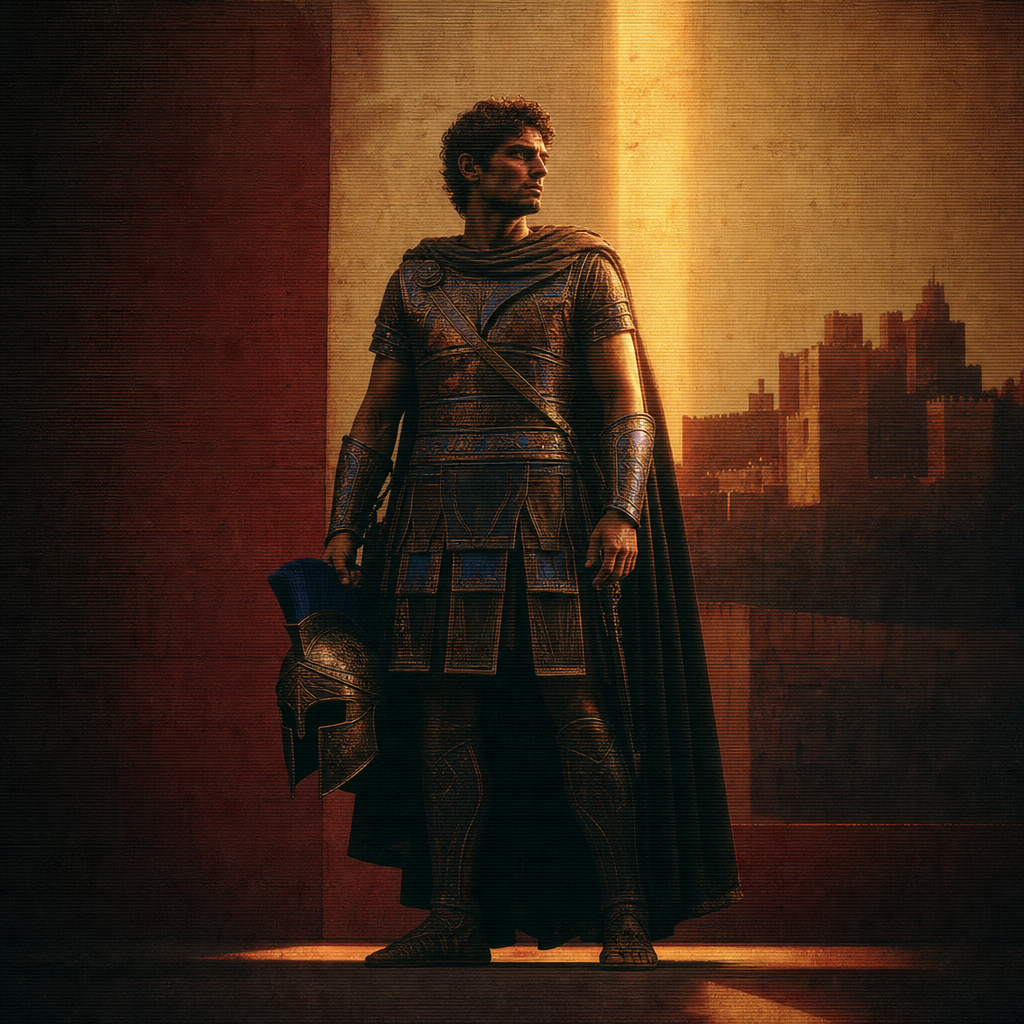
Once the Trojans had fled back through the stakes and across the trench, with many cut down at the hands of the Danaans, they halted beside their chariots and waited there, pale with terror and routed in panic. Then Zeus awoke on the peaks of Ida beside Hera of the golden throne. He sprang to his feet and stood looking out over the Trojans and Achaeans—the Trojans driven in confusion, and the Argives pressing hard behind them with Lord Poseidon in their midst. He saw Hector lying on the plain with his companions sitting around him; Hector was gripped by painful gasping, his senses dazed, vomiting blood, for it was not the weakest of the Achaeans who had struck him. Seeing him, the father of men and gods felt pity; and glaring darkly at Hera in terrible anger, he spoke to her:
Read Ancient Greek Source (Iliad.15.1–Iliad.15.13)
"Without a doubt, incorrigible Hera, your malicious trick has put noble Hector out of the fighting and stampeded his men. Indeed, I do not know whether once again you will be the first to reap the reward of your painful scheming, when I lash you with blows. Do you not remember when you hung high aloft, and from your feet I slung two anvils, and around your wrists I fastened an unbreakable chain of gold? There you hung in the upper air and the clouds, while the gods throughout high Olympus raged, unable to come to your side and set you free. Whomever I caught, I seized and hurled from the threshold until he reached the earth, barely breathing. Even then my heart was not relieved of its relentless pain for godlike Heracles, whom you, winning over the storm-blasts with the North Wind's help, drove across the barren sea in your wicked scheming, and afterward carried off course to well-settled Cos. I rescued him from there and brought him back again to horse-pasturing Argos, after all the labors he had endured. I will remind you of all this again so that you stop your deceptions, and so that you see whether your lovemaking and the bed help you—where you lay with me when you came away from the gods and deceived me."
Read Ancient Greek Source (Iliad.15.14–Iliad.15.33)
So he spoke, and ox-eyed Queen Hera shuddered; raising her voice, she addressed him with winged words: "Let Earth know this now, and broad Heaven above, and the cascading water of the Styx—which is the greatest and most terrible oath among the blessed gods—and your own sacred head, and the wedded bed that belongs to us two alone, by which I would never swear in vain: it is not by my will that Poseidon the Earth-Shaker harms the Trojans and Hector and helps the others; no, his own heart must be urging and driving him on, because he saw the Achaeans hard-pressed by the ships and pitied them. Yet even so, I would advise him myself to take whatever path you lead, Lord of the Dark Clouds."
Read Ancient Greek Source (Iliad.15.34–Iliad.15.46)
So she spoke, and the father of men and gods smiled, and answering her he spoke winged words: "If indeed from now on, ox-eyed Queen Hera, you sit among the immortals sharing one mind with me, then Poseidon, even if he strongly wishes otherwise, will quickly turn his purpose to match your heart and mine.
Read Ancient Greek Source (Iliad.15.47–Iliad.15.52)
"But if you are speaking the plain and honest truth, go now to the company of the gods and summon Iris to come here, and Apollo, famed for his bow, so that she may go to the army of the bronze-clad Achaeans and tell Lord Poseidon to break off from the war and return to his own halls, while Phoebus Apollo rouses Hector for battle, breathes fresh strength into him, and makes him forget the pains that now wear down his spirit, and turns the Achaeans back again by stirring up helpless rout, so that in their flight they fall back upon the many-benched ships of Achilles, son of Peleus. Then Achilles will send out his companion Patroclus; and glorious Hector will kill him with his spear in front of Ilium, after Patroclus has slain many other young warriors, and among them my own son, noble Sarpedon. Enraged over Patroclus, brilliant Achilles will kill Hector. From that moment on, I will drive a constant, unbroken counterattack back from the ships until the Achaeans capture steep Ilium through the designs of Athena. Before then, I will neither cease from my anger nor allow any other of the immortals to defend the Danaans here, not until the desire of Peleus's son has been fulfilled, just as I first promised him and bowed my head in assent on that day when the goddess Thetis clasped my knees, begging me to honor Achilles, sacker of cities."
Read Ancient Greek Source (Iliad.15.53–Iliad.15.77)
So he spoke, and the white-armed goddess Hera did not disobey, but went from the mountains of Ida to high Olympus. Just as the thought of a man darts—a man who has traveled over much of the earth and in his sharp mind thinks, "I wish I were there, or there," turning over many desires—so swiftly in her eagerness Queen Hera flew through the air. She reached steep Olympus and came among the immortal gods gathered in the house of Zeus. When they saw her, they all rose at once and greeted her with their cups. She passed the others by, but accepted a cup from lovely-cheeked Themis; for Themis was the first to come running to meet her, and raising her voice she addressed Hera with winged words: "Hera, why have you come? You look like someone in terror. Surely the son of Cronus, your own husband, has frightened you."
Read Ancient Greek Source (Iliad.15.78–Iliad.15.91)
Then the white-armed goddess Hera answered her: "Goddess Themis, do not question me about this; you know yourself how overbearing and unyielding his spirit is. Come, preside for the gods over the shared feast in the halls; and you will hear all this along with all the immortals—what grim deeds Zeus is declaring. I do not think every heart alike will rejoice, neither among mortals nor among gods, even if someone is still feasting cheerfully now."
Read Ancient Greek Source (Iliad.15.92–Iliad.15.99)
With these words Queen Hera sat down, and the gods were troubled throughout the hall of Zeus. She laughed with her lips, yet her forehead above her dark brows did not warm; and in indignation she spoke among them all: "Fools that we are, raging against Zeus in our senselessness! Even now we are eager to approach him and hold him back by word or by force; yet he sits apart and does not care or flinch, for he claims that among the immortal gods he is unmistakably the strongest in power and might. So endure whatever trouble he sends upon each of you. Even now I think disaster has fallen on Ares: his son has perished in the fighting, the dearest of men to him, Ascalaphus, whom mighty Ares claims as his own."
Read Ancient Greek Source (Iliad.15.100–Iliad.15.112)
So she spoke, and Ares struck his sturdy thighs with the flats of his hands, and crying out in grief he said: "Do not blame me now, you who dwell in the halls of Olympus, if I go to the ships of the Achaeans to avenge the killing of my son, even if it is my fate to be struck by Zeus's thunderbolt and lie with the corpses in the blood and dust." So he spoke, and he commanded Terror and Rout to yoke his horses, while he himself put on his blazing armor. Then an even greater and more bitter anger and wrath from Zeus would have fallen upon the immortals, had not Athena, fearing deeply for all the gods, sprung out through the entry hall, leaving the throne where she sat. She took the helmet from his head and the shield from his shoulders, and taking the bronze spear from his strong hand she set it upright, and rebuked furious Ares with her words:
Read Ancient Greek Source (Iliad.15.113–Iliad.15.127)
"Madman, crazed in your wits, you are undone! Truly it is for nothing that you have ears to hear, and your sense and shame are gone. Do you not hear what the white-armed goddess Hera says, who has just now come back from Olympian Zeus? Or do you want to fill up your own measure of misery first and be forced back to Olympus despite your grief, while planting great disaster for all the rest of us? For at once he will leave the proud Trojans and the Achaeans behind and come to Olympus to batter us into turmoil, seizing us one after another, the guilty and the innocent alike. So I urge you now to let go your anger for your noble son. Someone even stronger than he and mightier of hand has already been killed, or will yet be killed hereafter; it is hard to save the lineage and offspring of all mortal men." So speaking, she seated furious Ares back upon his throne.
Read Ancient Greek Source (Iliad.15.128–Iliad.15.142)
Then Hera called Apollo outside the hall, along with Iris, the messenger among the immortal gods, and raising her voice she addressed them with winged words: "Zeus orders the two of you to go to Ida as quickly as you can; and when you arrive and look upon the face of Zeus, do whatever he urges and commands you to do." With those words Queen Hera went back inside and sat upon her throne, while the two of them sprang away in flight. They came to many-springed Ida, mother of wild beasts, and found the far-sounding son of Cronus seated on the peak of Gargarus, with a fragrant cloud wreathed around him. Coming before Zeus the cloud-gatherer, the two halted; and when he saw them his heart was not angry, because they had quickly obeyed the words of his dear wife.
Read Ancient Greek Source (Iliad.15.143–Iliad.15.156)
To Iris first he spoke winged words: "Go now, swift Iris, to Lord Poseidon; deliver all this message to him, and do not be a false messenger. Order him to break off from the fighting and the war, and go either to the company of the gods or into the bright sea. If he will not obey my words, but disregards them, let him consider then in his mind and in his heart whether, strong though he is, he will dare to stand his ground when I come against him; for I declare that I am far greater than he in might and elder by birth, yet his heart does not shrink from claiming to be my equal, though others shudder before me."
Read Ancient Greek Source (Iliad.15.157–Iliad.15.167)
So he spoke, and wind-footed swift Iris did not disobey, but went down from the mountains of Ida to sacred Ilium. Just as snow or cold hail flies from the clouds under the blast of the clear-sky North Wind, so swiftly in her eagerness fleet Iris flew through the air; and standing close beside the glorious Earth-Shaker, she spoke to him: "I have come here bringing a message for you, dark-haired Earth-Holder, from Zeus who bears the aegis. He orders you to break off from the fighting and the war, and go either to the company of the gods or into the bright sea. If you will not obey his words, but disregard them, he threatens that he too will come here to fight you face to face; and he warns you to keep clear of his hands, since he declares that he is far greater than you in might and elder by birth, yet your heart does not shrink from claiming to be his equal, though others shudder before him."
Read Ancient Greek Source (Iliad.15.168–Iliad.15.183)
Deeply angered, the glorious Earth-Shaker answered her: "Outrageous! Mighty though he is, he has spoken with sheer arrogance if he means to restrain me by force against my will, when I am his equal in honor. For we are three brothers born of Cronus, whom Rhea bore: Zeus and I, and the third is Hades, lord of the dead below. All things were divided in three, and each of us received his domain: when the lots were shaken, I drew the gray sea to dwell in forever, Hades drew the murky darkness, and Zeus drew the wide heaven, in the upper air and the clouds; but the earth and high Olympus are still common to us all. So I will not live at the bidding of Zeus's mind; no, strong though he is, let him stay quietly in his own third share. And let him not try to terrify me with his hands as if I were a coward. He would do better to rail with terrible words at his own daughters and sons, the children he himself fathered, who will have to listen when he commands them."
Read Ancient Greek Source (Iliad.15.184–Iliad.15.199)
Then wind-footed swift Iris answered him: "Am I really then, dark-haired Earth-Holder, to carry back to Zeus this harsh and unyielding message, or will you change your mind a little? The hearts of the noble can be turned. You know how the Furies always attend the elder-born." Then Poseidon the Earth-Shaker said to her in reply: "Goddess Iris, you have spoken this word most fittingly; it is a fine thing when a messenger knows what is right. Yet a bitter grief comes over my heart and spirit whenever he chooses to rail with angry words at one of equal share, appointed to the same destiny. Still, for now, indignant though I am, I will yield. But I will tell you another thing, and make this threat from my heart: if against my will and that of Athena the driver of spoil, and of Hera and Hermes and Lord Hephaestus, he spares steep Ilium and refuses to sack it utterly and grant great victory to the Argives, let him know this—between the two of us there will be wrath beyond healing." So speaking, the Earth-Shaker left the Achaean army and went and plunged into the sea, and the Achaean heroes missed him.
Read Ancient Greek Source (Iliad.15.200–Iliad.15.219)
Then cloud-gathering Zeus spoke to Apollo: "Go now, dear Phoebus, to Hector in his bronze helmet. For the earth-encircling shaker of the land has already gone into the bright sea, avoiding the sheer force of my anger; otherwise even those others would have heard our clash, the gods down below who are around Cronus. Yet this proved far better for me and for him alike, that for all his indignation he yielded beforehand to my hands, since the matter would not have been settled without sweat. Now take the tasseled aegis in your hands, and shake it fiercely to rout the Achaean heroes. Make glorious Hector your own charge, far-shooter: rouse great strength in him until the Achaeans flee all the way to their ships and the Hellespont. From there I myself will devise both word and deed, so that the Achaeans may once again catch their breath from the hard fighting."
Read Ancient Greek Source (Iliad.15.220–Iliad.15.235)
So he spoke, and Apollo did not disobey his father. He went down from the mountains of Ida like a hawk, the swift dove-killer, fastest of all winged creatures. He found noble Hector, son of wise Priam, sitting up; he was no longer lying flat, and was just gathering back his senses, recognizing his companions around him, while his gasping and sweat were subsiding, since the will of aegis-bearing Zeus was reviving him. Standing close beside him, far-working Apollo spoke: "Hector, son of Priam, why are you sitting here so faint, apart from the others? Has some trouble come upon you?" Still weak and struggling, Hector of the flashing helmet answered him: "And who are you, mightiest of gods, who question me face to face? Have you not heard how, by the sterns of the Achaean ships as I was slaughtering his comrades, Ajax of the great war cry struck me in the chest with a boulder and stopped my furious valor? Truly I thought I would go down to the dead and the house of Hades this very day, as I gasped out my life's breath."
Read Ancient Greek Source (Iliad.15.236–Iliad.15.252)
Then far-working Lord Apollo answered him: "Take heart now; so great a helper has the son of Cronus sent down from Ida to stand beside you and defend you—Phoebus Apollo of the golden sword, I who have guarded you before now, both you yourself and your steep citadel. Come then, urge on your many charioteers to drive their swift horses against the hollow ships. I myself will go ahead and smooth the whole path for the horses, and I will turn the Achaean heroes to flight."
Read Ancient Greek Source (Iliad.15.253–Iliad.15.261)
With these words he breathed great strength into the shepherd of the people. And just as a stalled stallion, well fed on barley at the manger, snaps his tether and gallops across the plain with drumming hooves, accustomed to bathing in the bright waters of a fair-flowing river and exulting in his strength—he holds his head high while his mane streams over his shoulders, and as he glories in his own splendor, his knees carry him lightly to the familiar haunts and pastures of the mares—so Hector swiftly plied his feet and knees, urging on the charioteers once he heard the voice of the god.
Read Ancient Greek Source (Iliad.15.262–Iliad.15.270)
And just as hounds and country men give chase to a horned stag or a wild goat, yet a sheer crag and a shadowy forest save the beast because it is not their fate to catch it, and at their shouting a bearded lion appears across their path and at once turns them all back, eager though they are—so the Danaans for a time kept pressing after in a pack, stabbing with swords and double-pointed spears; but when they saw Hector ranging along the ranks of men, they were terrified, and the courage of every man dropped to his feet.
Read Ancient Greek Source (Iliad.15.271–Iliad.15.280)
Then Thoas, son of Andraemon, spoke among them—by far the best of the Aetolians, skilled with the javelin and staunch in close combat, while in council few of the Achaeans could surpass him when the young men contended in debate. With wise counsel he addressed them and said: "What a great wonder is this that I see with my own eyes, how Hector has risen up once again, escaping the fates of death! Surely every man's heart was confident that he had died at the hands of Ajax, son of Telamon. Yet one of the gods has again rescued and saved Hector, who has already unstrung the knees of many Danaans, and will do so again now, I think; for not without loud-thundering Zeus does he stand in the forefront so full of fury. Come then, let us all do as I say. Let us order the main body of the troops to fall back toward the ships, while we ourselves, all who claim to be the best in the army, take our stand to see if we can meet him first and hold him off with lifted spears. Even in his fury, I think he will fear at heart to plunge into our band of Danaans."
Read Ancient Greek Source (Iliad.15.281–Iliad.15.299)
So he spoke, and they readily listened and obeyed. Those around Ajax and Lord Idomeneus, Teucer, Meriones, and Meges, the equal of Ares, called the chieftains together and drew up their battle line to face Hector and the Trojans, while behind them the mass of the army withdrew toward the Achaean ships. The Trojans surged forward in a mass, and Hector led them with long strides. In front of him went Phoebus Apollo, his shoulders wrapped in cloud, holding the tempestuous aegis—terrible, fringed all around, and dazzling—which the smith Hephaestus gave to Zeus to carry for the rout of men. Holding this in his hands, Apollo led on the troops. The Argives stood their ground in close ranks, and a shrill battle cry rose from both sides; arrows leapt from bowstrings, and many spears were hurled from bold hands: some lodged in the flesh of swift-fighting young warriors, and many more, in the space between, before they could reach white skin, stood fixed in the earth, hungering to glut themselves on flesh.
Read Ancient Greek Source (Iliad.15.300–Iliad.15.317)
So long as Phoebus Apollo held the aegis still in his hands, the missiles struck home on both sides and the men kept falling. But when he looked the Danaans of the swift horses straight in the face and shook it, roaring out with a tremendous shout himself, he cast a spell over the spirit within their chests, and they forgot their furious valor. Just as two wild beasts in the dead of black night stampede a herd of cattle or a great flock of sheep, falling on them suddenly when no herdsman is near, so the Achaeans scattered in helpless panic; for Apollo sent terror among them, and gave glory to Hector and the Trojans.
Read Ancient Greek Source (Iliad.15.318–Iliad.15.327)
Then man killed man as the battle line broke apart. Hector killed Stichius and Arcesilaus—one a leader of the bronze-clad Boeotians, the other a trusted companion of great-hearted Menestheus. Aeneas killed and stripped Medon and Iasus. Medon was the bastard son of godlike Oileus and brother to Ajax, though he lived in Phylace, far from his fatherland, after killing a man—the brother of his stepmother Eriopis, whom Oileus had married. Iasus, in turn, had been made a commander of the Athenians, and was called the son of Sphelus, son of Bucolus. Polydamas killed Mecisteus, and Polites struck down Echius at the front of the clash, while noble Agenor killed Clonius. And Paris struck Deiochus from behind at the base of the shoulder as he fled among the front fighters, and drove the bronze clean through.
Read Ancient Greek Source (Iliad.15.328–Iliad.15.342)
While the Trojans were stripping the armor from these men, the Achaeans stumbled into the dug trench and the palisade stakes, fleeing this way and that, and were forced back inside their wall. Then Hector gave a great shout and called out to the Trojans to charge the ships and leave the bloodstained spoils behind: "Any man I spot holding back from the ships on the other side, I will contrive his death right there, and once he is dead his brothers and sisters will never give him his share of the funeral fire; instead, dogs will tear him apart in front of our city!"
Read Ancient Greek Source (Iliad.15.343–Iliad.15.351)
With that, he swung the whip from his shoulder and drove his horses on, calling to the Trojans along the ranks; and alongside him they all shouted together and steered their chariot-drawing horses with an unearthly roar. Ahead of them went Phoebus Apollo, effortlessly kicking down the banks of the deep trench with his feet and tumbling the earth into the middle, bridging a long, wide causeway across—as far as the cast of a spear reaches when a man hurls it to test his strength. Over that causeway they poured forward column by column, with Apollo in front holding the priceless aegis. He toppled the wall of the Achaeans with utter ease, just as a child by the sea plays with the sand, building playthings in his childish delight and then in his play sweeping them flat again with hands and feet. Just so, archer Phoebus, you swept flat all the hard work and painful labor of the Argives, and stirred panic among the men themselves.
Read Ancient Greek Source (Iliad.15.352–Iliad.15.366)
So the Achaeans halted and stood their ground beside the ships, calling out to one another and lifting their hands to all the gods, each man praying aloud. Above all the rest, Gerenian Nestor, guardian of the Achaeans, prayed, stretching his hands toward the starry sky: "Father Zeus, if ever anyone in wheat-rich Argos burned for you the fat thigh-pieces of an ox or a sheep and prayed to return home, and you promised and nodded your assent, remember those offerings now, Olympian, and ward off the pitiless day of death; do not let the Achaeans be crushed like this by the Trojans." So he spoke in prayer, and wise Zeus thundered loud, hearing the prayers of the old man, Neleus's son.
Read Ancient Greek Source (Iliad.15.367–Iliad.15.378)
When the Trojans heard the thunder of aegis-bearing Zeus, they lunged all the harder at the Argives and threw themselves into the fight. Just as a huge wave of the wide-wayed sea crashes down over the sides of a ship when driven on by the force of the wind—for it is the wind above all that swells the waves—so the Trojans, with a great roar, poured down over the wall. Driving their horses inside, they fought at the sterns of the ships at close quarters with double-pointed spears—the Trojans from their chariots, and the Achaeans climbing high on the decks of their black ships, wielding the long pikes that lay stored aboard the vessels for fighting at sea, jointed poles shod at the tip with bronze.
Read Ancient Greek Source (Iliad.15.379–Iliad.15.389)
Now while the Achaeans and Trojans were fighting around the wall outside the swift ships, Patroclus sat in the shelter of gallant Eurypylus, keeping him company with talk, and over his grievous wound he sprinkled healing herbs to soothe the dark pains. But when he saw the Trojans rushing over the wall, while shouting and panic rose from the Danaans, he groaned aloud, struck both his thighs with the flats of his hands, and spoke in anguish: "Eurypylus, much as you need me, I can no longer stay here by your side, for a great battle has broken out. Let your attendant care for you now, while I hurry back to Achilles to urge him into the fight. Who knows? With a god's help I may stir his heart with my words; the persuasion of a friend is a good thing."
Read Ancient Greek Source (Iliad.15.390–Iliad.15.404)
When he had spoken, his feet carried him away. Meanwhile the Achaeans stood firm against the oncoming Trojans, yet could not push them back from the ships, even though the Trojans were fewer; nor could the Trojans ever break the Danaan ranks and force their way in among the shelters and the ships. Instead, just as a chalk-line trues a ship's timber in the hands of a skilled shipwright who knows all the mastery of his craft through the guidance of Athena, so taut and even was the line of their battle and war. Different men fought around different ships along the line, but Hector went straight against glorious Ajax. Those two labored over a single ship: neither could Hector drive Ajax off and set the ship ablaze with fire, nor could Ajax thrust Hector back, since a god had brought him close.
Read Ancient Greek Source (Iliad.15.405–Iliad.15.418)
Then shining Ajax struck Caletor, son of Clytius, in the chest with a spear as he was carrying fire toward the ship. He fell with a thud, and the torch dropped from his hand. When Hector saw with his own eyes his cousin fallen in the dust in front of the black ship, he gave a great shout and called to the Trojans and Lycians: "Trojans, Lycians, and Dardanians who fight at close quarters, do not give ground from the fight in this narrow pass, but save the son of Clytius, so the Achaeans do not strip his armor now that he has fallen among the gathered ships!" So speaking, he hurled his shining spear at Ajax. He missed him, but struck Lycophron, son of Mastor, Ajax's Cytherian attendant, who lived at his side because he had killed a man in sacred Cythera. Hector hit him on the head above the ear with the sharp bronze as he stood beside Ajax; backward into the dust he fell to the ground from the ship's stern, and his limbs went slack.
Read Ancient Greek Source (Iliad.15.419–Iliad.15.435)
Ajax shuddered, and called out to his brother: "Dear Teucer, our trusted companion has been killed—Mastor's son, who came from Cythera to live with us, and whom we honored in our halls like our own dear parents. Great-hearted Hector has killed him. Where now are your arrows that bring swift death, and the bow that Phoebus Apollo gave you?" So he spoke, and Teucer understood; running up, he stood close beside him, holding in his hand his reflex bow and his arrow-holding quiver, and quickly he let fly his shafts at the Trojans. He struck Cleitus, the splendid son of Peisenor and companion of Polydamas, the noble son of Panthous, as he held the reins in his hands. Cleitus was laboring with his horses, driving them where the thickest ranks were thrown into turmoil to do service to Hector and the Trojans; but soon disaster came upon him, which no one could ward off from him despite their eagerness. For the grievous arrow plunged into the back of his neck; he tumbled from the chariot, and his horses shied back, rattling the empty car. Their master Polydamas saw it at once and was the first to come out in front of the horses. He handed them over to Astynous, son of Protiaon, and gave him strict orders to keep the horses close by while watching him; then he went back himself and joined the front fighters.
Read Ancient Greek Source (Iliad.15.436–Iliad.15.457)
Teucer drew out another arrow for bronze-helmed Hector, and he would have stopped Hector's fighting beside the Achaean ships if he had struck him while he excelled in the fray and taken his life. But it did not escape the shrewd mind of Zeus, who was guarding Hector and robbed Telamonian Teucer of the glory: Zeus snapped the tightly twisted cord on Teucer's faultless bow just as the archer drew it against Hector; the bronze-weighted arrow went wide to one side, and the bow fell from Teucer's hand. Teucer shuddered, and spoke to his brother: "Oh no—surely a god is cutting short all our battle plans, striking the bow out of my hand and snapping the newly twisted bowstring that I tied on this morning so it would hold up under the arrows leaping thick and fast." Great Telamonian Ajax answered him: "My friend, leave your bow and your thick sheaf of arrows to lie there, since a god has confounded them out of begrudging spite toward the Danaans; take a long spear in your hands instead, and a shield on your shoulder, and fight the Trojans and rally the rest of the men. Even if they overpower us, let them not take our well-benched ships without a struggle—let us set our minds on the fight!"
Read Ancient Greek Source (Iliad.15.458–Iliad.15.477)
So he spoke, and Teucer laid the bow away inside his shelter. Around his shoulders he slung a shield of four layers of hide, and on his strong head he set a well-made helmet with a horsehair crest, and the plume nodded terribly from above; he took up a stout spear tipped with sharp bronze, and set out, and running quickly he took his stand beside Ajax. When Hector saw Teucer's shots thwarted, he called out to the Trojans and Lycians with a loud shout: "Trojans, Lycians, and Dardanians who fight at close quarters, be men, my friends, and summon your furious valor along the hollow ships! For I have just seen with my own eyes a chief warrior's shafts thwarted by Zeus. The supporting power of Zeus is easy for men to recognize, both toward those into whose hands he puts the higher glory and toward those whom he weakens and refuses to defend, just as now he weakens the might of the Argives and helps us. So fight together in close ranks at the ships! And whoever among you, struck from afar or stabbed up close, meets his death and fate, let him die. It is no disgrace for a man to die defending his country; his wife and children will be safe after him, and his house and allotment of land unharmed, if the Achaeans depart with their ships to their own dear native land." With these words he stirred the strength and spirit of every man.
Read Ancient Greek Source (Iliad.15.478–Iliad.15.500)
On the other side, Ajax called out to his companions: "Shame, Argives! Now the choice is clear: either to perish, or to save ourselves and drive disaster back from the ships. Or do you expect that if Hector of the flashing helmet takes the ships, each of you will walk home on foot to his own native land? Do you not hear Hector urging on his whole army, raging to set the ships ablaze? He is not inviting them to a dance, but to fight! For us there is no better plan or counsel than this: to bring our hands and our strength together in close combat. Better to die once and for all, or live, than to be slowly wrung dry in grim slaughter like this, to no purpose, beside the ships at the hands of worse men." With these words he stirred the strength and spirit of every man.
Read Ancient Greek Source (Iliad.15.501–Iliad.15.514)
Then Hector killed Schedius, son of Perimedes, leader of the Phocians; Ajax killed Laodamas, commander of the foot soldiers and Antenor's splendid son; and Polydamas killed and stripped Otus of Cyllene, companion of Phyleus's son and leader of the great-hearted Epeians. Meges saw it and lunged at Polydamas, but he slipped aside from under the blow, and Meges missed him; for Apollo would not allow the son of Panthous to be brought down among the front fighters. Instead, Meges stabbed Croesmus with his spear right in the center of his chest. He fell with a thud, and Meges began stripping the armor from his shoulders. Meanwhile Dolops, a fighter skilled with the spear, lunged at Meges. He was the finest son of Lampus, son of Laomedon, and well versed in furious combat. Rushing in at close quarters, Dolops stabbed the center of the shield of Phyleus's son with his spear; but the close-fitted corselet of curved bronze plates that Meges wore protected him. Phyleus had once brought it from Ephyra, from the River Selleis, for his guest-friend Euphetes, lord of men, had given it to him to wear into battle as a defense against enemy fighters; and now it warded destruction away from the flesh of his son.
Read Ancient Greek Source (Iliad.15.515–Iliad.15.534)
Meges struck at the topmost socket of Dolops's horsehair-crested bronze helmet with his sharp spear and sheared away its horsehair plume; the whole crest fell to the ground in the dust, gleaming bright with its new crimson dye. While Dolops stood fighting him and still hoped for victory, warlike Menelaus came up to help Meges. Slipping in unseen at his flank with a spear, he struck Dolops in the shoulder from behind; the point sped eagerly on, tearing right through his chest, and he pitched forward face down.
Read Ancient Greek Source (Iliad.15.535–Iliad.15.543)
The two of them rushed in to strip the bronze armor from his shoulders. Then Hector called out to all his kinsmen, and first of all he rebuked Hicetaon's son, mighty Melanippus. For a time Melanippus had pastured his shambling cattle in Percote while the enemy were still far away; but when the curved ships of the Danaans arrived, he came back to Ilium, where he stood out among the Trojans, and lived beside Priam, who honored him like his own sons. Hector rebuked him, and called him by name and spoke: "Are we going to slacken like this, Melanippus? Does even your heart not turn within you now that your cousin has been killed? Do you not see how they are busying themselves over Dolops's armor? Come with me; we can no longer fight the Argives from a distance, not until either we kill them or they take steep Ilium from its topmost citadel and slaughter its citizens." With these words he led the way, and the godlike man followed with him.
Read Ancient Greek Source (Iliad.15.544–Iliad.15.559)
Meanwhile great Telamonian Ajax urged on the Argives: "Friends, be men, and put a sense of honor in your hearts; show respect before one another in the fierce press of battle. When men hold fast to honor, more are saved than slain; but when they flee, neither glory nor any defense arises." So he spoke, and they themselves were already eager to beat the enemy back; they took his words to heart and fenced the ships with a wall of bronze, while Zeus urged the Trojans on against them. Then Menelaus of the great war cry urged on Antilochus: "Antilochus, no other man of the Achaeans is younger than you, nor swifter of foot, nor as strong as you in battle. See if you can leap out and strike down some warrior of the Trojans!" So speaking, he darted back again, after rousing Antilochus.
Read Ancient Greek Source (Iliad.15.560–Iliad.15.572)
Antilochus leapt out from the front ranks, glanced sharply around him, and hurled his shining spear. The Trojans gave way as the man cast, and he did not launch his shaft in vain, but struck Hicetaon's proud son Melanippus in the chest beside the nipple as he was advancing into battle. He fell with a thud, and darkness covered his eyes. Antilochus sprang upon him like a hound that darts upon a wounded fawn which a hunter has hit as it leapt from its covert, unstringing its limbs; just so against you, Melanippus, staunch Antilochus leapt to strip your armor. Yet he did not escape the notice of noble Hector, who came running through the carnage to meet him. Antilochus did not hold his ground, swift fighter though he was, but shrank back like a wild beast that has done some mischief—killing a dog or a herdsman beside the cattle—and flees before a crowd of men can gather; so the son of Nestor shrank back, while the Trojans and Hector with an unearthly roar poured a shower of groaning missiles after him. Only when he reached the company of his comrades did he turn and stand fast.
Read Ancient Greek Source (Iliad.15.573–Iliad.15.591)
The Trojans, like raw-flesh-eating lions, charged at the ships and were fulfilling the commands of Zeus, who kept rousing great strength in them while he cast a spell over the spirit of the Argives and took away their glory, urging the Trojans on. For his heart was set on granting glory to Hector, son of Priam, so that he might hurl tireless, blazing fire upon the curved ships and fulfill to the uttermost the fateful prayer of Thetis; for wise Zeus was waiting to see with his own eyes the glare of a burning ship. From that moment on, he meant to drive the Trojans back from the ships in a counterattack and grant glory to the Danaans. With this in mind, he roused Hector, son of Priam, against the hollow ships, though Hector was already fiercely eager himself. He raged like spear-brandishing Ares, or like destructive fire raging in the mountains through the thickets of a deep forest; foam gathered around his mouth, his two eyes blazed beneath his grim brows, and the helmet about his temples shook terribly as Hector fought. For Zeus himself from the upper air was his helper, and honored and glorified him alone among so many men; for Hector was to be short-lived, since already Pallas Athena was hastening on his fateful day beneath the might of Peleus's son.
Read Ancient Greek Source (Iliad.15.592–Iliad.15.614)
Wherever Hector saw the thickest press and the finest armor, there he tested the ranks of men and tried to break through; yet even so he could not break them, fiercely though he strove, for they held firm, locked together like a wall—just like a great, sheer crag standing by the gray sea that withstands the swift paths of whistling winds and the swollen waves that burst against it; so the Danaans stood firm against the Trojans and did not flee. Blazing with fire on every side, he leapt into the throng and fell upon them as a violent, wind-fed wave under the clouds falls upon a swift ship: the whole vessel is hidden in spray, the terrible blast of the wind roars in the sail, and the sailors' hearts tremble in terror as they are carried along a hair's breadth from death; so the spirit was torn in the chests of the Achaeans.
Read Ancient Greek Source (Iliad.15.615–Iliad.15.629)
And just as a murderous lion falls upon cattle grazing by the thousands in the low-lying meadow of a great marsh, tended by a herdsman who does not yet know clearly how to fight a wild beast to keep a curve-horned cow from being slaughtered—he keeps pacing with the front or the rear of the herd, while the lion springs into the middle and devours a cow, and all the rest scatter in terror—so then the Achaeans were all driven in unearthly panic by Hector and Father Zeus; yet Hector killed only one man, Periphetes of Mycenae. He was the dear son of Copreus, who used to go as King Eurystheus's messenger to the mighty Heracles. From that far baser father was born a son better in every kind of excellence, both in fleetness of foot and in fighting, and in counsel he was among the foremost men of Mycenae; and now he placed higher glory into Hector's hands. For as he turned back, he tripped against the rim of his own shield, which reached to his feet and which he carried as a defense against javelins; entangled in it, he fell flat on his back, and his helmet rang terribly around his temples as he hit the ground. Hector saw it sharply, ran up and stood close beside him, and drove a spear into his chest, killing him right near Periphetes's dear companions; and grieved though they were for their comrade, they could not help him, for they themselves were terrified of noble Hector.
Read Ancient Greek Source (Iliad.15.630–Iliad.15.652)
Now they were in among the ships, and the outermost ships that had been hauled up first hemmed them in, while the Trojans poured in after them. Driven by necessity, the Argives gave way from the first row of ships, but beside the shelters they stood their ground in a tight mass and did not scatter through the camp; for shame and fear held them fast, and they kept shouting ceaselessly to one another. Above all the rest, Gerenian Nestor, guardian of the Achaeans, implored each man, entreating him by his parents: "Friends, be men, and put in your hearts a sense of shame before other men! Remember, each one of you, your children and your wives, your possessions and your parents, whether your parents are still living or have died. For their sake—though they are not here—I beg you to stand firm and not turn to flight." With these words he stirred the strength and spirit of every man. And Athena pushed away from their eyes the unearthly cloud of mist, and light shone out clearly for them on both sides, both toward the ships and toward the leveling battle. Both the Achaeans who stood back in the rear and were not fighting and those who were fighting beside the swift ships could see Hector of the great war cry and his companions.
Read Ancient Greek Source (Iliad.15.653–Iliad.15.673)
It no longer pleased the heart of great-spirited Ajax to stand where the other sons of the Achaeans stood back; instead, he strode with long steps up and down the decks of the ships, wielding in his hands a great sea-fighting pike jointed with metal bands, twenty-two cubits long. Just as a man well skilled in riding coursers gathers four horses chosen out of many, and drives them at a gallop from the plain toward a great city along the public highway—many men and women gaze at him in wonder, while he keeps leaping surely and steadily without a slip, shifting from one horse to another as they fly along—so Ajax went with long strides across the many decks of the swift ships, and his voice reached the upper air as he shouted terribly without pause, calling on the Danaans to defend the ships and the shelters. Nor did Hector remain among the throng of closely armored Trojans; but just as a tawny eagle swoops upon a flock of winged birds feeding beside a river—geese, or cranes, or long-necked swans—so Hector darted straight for a dark-prowed ship, charging head-on; and from behind Zeus pushed him onward with his mighty hand, and urged the army on beside him.
Read Ancient Greek Source (Iliad.15.674–Iliad.15.695)
Once again a bitter battle was joined beside the ships. You would have said that they met each other in war fresh and unwearied, so fiercely did they fight. And as they fought, this was the thought in their minds: the Achaeans did not expect to escape from disaster, but thought they would perish, while in every Trojan's chest his heart hoped to burn the ships and kill the Achaean heroes. With these thoughts they closed upon one another. Then Hector seized the stern of a seafaring ship, a fine, swift vessel that had brought Protesilaus to Troy, but never carried him back to his native land. Around his ship the Achaeans and Trojans hacked at one another hand to hand. No longer did they stand apart and wait for the rush of arrows and javelins, but standing toe to toe with a single resolve they fought with sharp battle-axes and hatchets, with great swords and double-pointed spears. Many fine, dark-hilted, heavy-gripped swords fell to the ground, some from the hands and some from the shoulders of the fighting men, and the black earth ran with blood.
Read Ancient Greek Source (Iliad.15.696–Iliad.15.715)
Once Hector had seized the ship by the stern, he did not let go, holding the curved stern-post between his hands, and he shouted to the Trojans: "Bring fire, and all together raise the battle cry! Now Zeus has given us a day worth all the rest: to take the ships that came here against the will of the gods and brought us so many sorrows through the cowardice of our elders, who held me back when I wanted to fight at the sterns of the ships and kept the army in check. Even if far-sounding Zeus clouded our wits then, now he himself urges and commands us on!" So he spoke, and they charged all the harder at the Argives.
Read Ancient Greek Source (Iliad.15.716–Iliad.15.726)
Ajax could no longer hold his ground, for he was overwhelmed by missiles; expecting to die, he gave way a little onto the seven-foot rower's bench, leaving the deck of the trim ship. There he stood watching on guard, and with his spear he kept fending the Trojans away from the ships whenever anyone came bringing tireless fire; and shouting terribly without pause, he called out to the Danaans: "Friends, Danaan heroes, companions of Ares—be men, my friends, and summon your furious valor! Do we think we have helpers waiting behind us, or some stronger wall to ward off destruction from men? There is no city fitted with towers nearby where we could defend ourselves with a fresh force of townsmen to turn the tide; no, we sit here in the plain of the closely armored Trojans, backed up against the sea and far from our native land. So deliverance lies in our hands, not in any slackening of battle!" He spoke, and lunged furiously with his sharp spear. Whichever of the Trojans rushed against the hollow ships with blazing fire to please Hector who urged them on, Ajax waited for him and stabbed him with his long spear; and twelve men he stabbed hand to hand in front of the ships.